Why London Homes Need More Frequent Deep Cleaning

Why London Homes Need More Frequent Deep Cleaning
Keeping a home clean in London is often more challenging than many people expect. Even properties that appear tidy on the surface can quickly accumulate dust, pollutants, grease, allergens, and hidden grime due to the city’s environment and fast-paced lifestyle.
Compared to many other parts of the UK, London homes are exposed to higher levels of traffic pollution, construction dust, hard water buildup, and indoor humidity. These factors cause dirt and bacteria to build up much faster, making regular surface cleaning less effective over time.
This is why more homeowners, tenants, landlords, and busy professionals across London are turning to professional deep cleaning services to maintain healthier and more hygienic living spaces.
Specialist providers like Vamoose Cleaning Services help London households tackle the deeper buildup that standard weekly cleaning often misses.
Why London Homes Get Dirtier Faster
London’s urban environment creates unique cleaning challenges that are less common in quieter or less densely populated areas.
Air pollution, traffic emissions, construction work, and constant foot traffic all contribute to faster dust accumulation indoors. According to London cleaning industry guidance, homes in busy areas can develop noticeable dust buildup within just a few days after cleaning.
At the same time, indoor living patterns also increase cleaning demands. Many London residents spend long periods indoors, especially during colder months, which leads to more wear on kitchens, bathrooms, carpets, and soft furnishings.
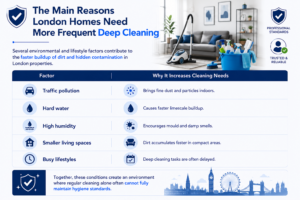
The Main Reasons London Homes Need More Frequent Deep Cleaning
Several environmental and lifestyle factors contribute to the faster buildup of dirt and hidden contamination in London properties.
| Factor | Why It Increases Cleaning Needs |
| Traffic pollution | Brings fine dust and particles indoors |
| Hard water | Causes faster limescale buildup |
| High humidity | Encourages mould and damp smells |
| Smaller living spaces | Dirt accumulates faster in compact areas |
| Busy lifestyles | Deep cleaning tasks are often delayed |
Together, these conditions create an environment where regular cleaning alone often cannot fully maintain hygiene standards.
Air Pollution and Indoor Dust Build-Up
One of the biggest reasons London homes require more deep cleaning is air pollution. UK Air Quality Data
Dust entering properties often contains a mixture of outdoor pollutants, fibres, pollen, construction residue, and microscopic particles. Cleaning experts note that poor airflow, traffic pollution, and urban density all contribute to rapid indoor dust accumulation.
Even with frequent vacuuming, dust often settles in:
- Skirting boards
- Upholstery and carpets
- Behind furniture
- Window tracks and vents
- Curtains and soft furnishings
Over time, these hidden areas collect allergens and grime that normal cleaning routines may not fully remove.
Hard Water Creates Constant Limescale Problems
London is known for having particularly hard water, which means homes experience much faster limescale buildup than many other parts of the UK.
This affects:
- Shower screens
- Bathroom tiles
- Taps and sinks
- Kettles and appliances
- Grout and pipework
According to London cleaning specialists, hard water buildup can become difficult to remove if left untreated for long periods.
Regular deep cleaning helps prevent permanent staining and keeps bathrooms and kitchens in better long-term condition.
Humidity and Mould Are Common Problems
Humidity is another major issue in many London homes, especially flats, converted properties, and buildings with limited ventilation.
Condensation and moisture can quickly lead to:
- Damp smells
- Mould growth
- Bathroom mildew
- Dust mite buildup
- Poor indoor air quality
Cleaning and air-quality experts regularly warn that high humidity increases allergen buildup and mould risk indoors.
Deep cleaning helps target damp-prone areas that routine cleaning often overlooks.
Busy Lifestyles Mean Hidden Dirt Builds Up
Many London residents have demanding schedules and limited time for intensive household cleaning.
As a result, everyday tidying usually focuses on visible areas while deeper cleaning tasks are postponed. Over time, grease, bacteria, dust, and hidden grime accumulate in areas such as:
- Behind kitchen appliances
- Under furniture
- Mattress edges
- Upholstered furniture
- High-touch surfaces
Cleaning industry guidance explains that deep cleaning removes contamination hidden beneath everyday surface cleaning.
This is especially important in high-traffic households or shared accommodation.
Smaller Spaces Often Get Dirtier Faster
Many London properties are more compact than homes elsewhere in the UK. Smaller spaces naturally experience concentrated daily use, meaning kitchens, bathrooms, and living areas deteriorate more quickly between cleans.
This often results in:
- Faster grease buildup
- More noticeable dust accumulation
- Reduced airflow
- Quicker odour retention
- Higher surface contact frequency
Because of this, even relatively tidy homes can still benefit significantly from regular deep cleaning schedules.
Deep Cleaning Helps Improve Indoor Air Quality
One of the most overlooked benefits of deep cleaning is improved indoor air quality.
Professional deep cleaning removes:
- Dust mites
- Pet dander
- Mould spores
- Embedded allergens
- Bacteria trapped in fabrics and carpets
According to professional cleaning guidance, deep cleaning can significantly improve indoor hygiene and reduce airborne contaminants that regular cleaning misses.
This can be especially valuable for households with:
- Children
- Pets
- Allergy sufferers
- Asthma or respiratory sensitivities

How Often Should London Homes Be Deep Cleaned?
The ideal frequency depends on the property type, lifestyle, and household conditions.
However, many professional cleaning experts recommend:
| Property Type | Recommended Deep Cleaning Frequency |
| Single-occupant flat | Every 4–6 months |
| Family home | Every 2–3 months |
| Homes with pets | Every 2–3 months |
| Shared accommodation | Every 2–3 months |
| Allergy-sensitive households | Every 6–8 weeks |
Industry cleaning recommendations consistently suggest that urban households benefit from more frequent deep cleaning than lower-density areas.
Why Professional Deep Cleaning Is Often More Effective
Professional deep cleaning goes beyond surface-level tidying.
Specialist cleaning teams use structured methods and equipment designed to remove contamination from areas that standard domestic cleaning usually cannot fully address.
This often includes:
- Detailed bathroom descaling
- Kitchen grease removal
- Carpet and upholstery deep cleaning
- Dust extraction from hidden areas
- Sanitisation of high-touch surfaces
Vamoose Cleaning Services provides deep cleaning services across London designed to help homes remain hygienic, fresh, and easier to maintain long term.
Conclusion
London homes face unique cleaning challenges caused by pollution, hard water, humidity, compact living spaces, and busy urban lifestyles.
While regular cleaning helps maintain appearance, deep cleaning is essential for removing hidden dirt, allergens, bacteria, and buildup that accumulates over time.
For many households across London, more frequent deep cleaning is not simply about presentation, it is an important part of maintaining a healthier, fresher, and more comfortable living environment.
Frequently Asked Questions
Why do London homes get dusty so quickly?
Traffic pollution, construction dust, poor airflow, and urban density all contribute to faster dust buildup indoors.
How often should a London home be deep cleaned?
Most London homes benefit from deep cleaning every 2–6 months depending on occupancy, pets, and lifestyle.
Does hard water affect cleaning in London?
Yes. Hard water causes faster limescale buildup on taps, tiles, showers, and appliances.
Can deep cleaning improve air quality?
Yes. Deep cleaning removes allergens, dust mites, mould spores, and hidden pollutants from the home.
What areas are usually included in a deep clean?
Bathrooms, kitchens, carpets, upholstery, skirting boards, hidden dust areas, and high-touch surfaces are commonly included.