How to Help a Family Member Who Hoards: A Compassionate Guide
If a family member’s home has become unsafe, overwhelming, or impossible to move through freely, you are probably feeling a complicated mix of worry, frustration, and helplessness – and that is completely understandable. Living with or caring for someone who hoards is one of the most emotionally exhausting experiences a family can face. You want to help, but you are not sure how to raise it, what to do, or whether anything will actually change.
You are not alone. Hoarding disorder affects an estimated 2 to 5 per cent of people in the UK and is now a recognised mental health condition – not a lifestyle choice, not stubbornness, and not a failure of effort. This guide is here to help you navigate the situation with both practical clarity and genuine compassion.
Understanding Hoarding: What It Is and Is Not
Hoarding disorder is formally recognised in both the ICD-11 (the World Health Organisation’s diagnostic framework) and the DSM-5 (used widely in psychiatric assessment). It is characterised by a persistent difficulty discarding or parting with possessions, regardless of their actual value – and by the significant distress that the idea of discarding causes.
It is not the same as being messy, disorganised, or a collector. The key difference is the level of distress involved and the degree to which the accumulation interferes with daily life.
Some common misconceptions worth addressing:
“They just need to make the effort.” Hoarding is not about motivation or willpower. The emotional attachment to objects is neurologically and psychologically real. Asking someone to simply throw things away can feel to them the way it would feel to you to be asked to throw away a family photograph or a medical document – but applied to everything in the home.
“It is an elderly person’s problem.” Hoarding behaviours typically begin in adolescence or early adulthood, according to research published by the International OCD Foundation, though they often become more visible as a person ages and accumulates more over time.
“One big clear-out will fix it.” Without addressing the underlying mental health dimension, a forced clear-out often results in re-accumulation – and can severely damage trust and the relationship.
Understanding this shifts the frame from frustration to empathy – and that shift is essential before any practical step can land.
The 5 Levels of Hoarding
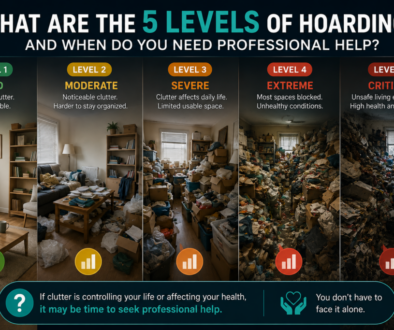
Hoarding severity is commonly assessed using a five-level scale, from Level 1 (minor clutter, no real safety risk) through to Level 5 (structural damage, unusable rooms, serious health hazards, and potential for pest infestation).
Vamoose has a dedicated post walking through each level in detail – read our full guide to the 5 levels of hoarding to understand where your loved one may sit on the scale and what that means practically.
As a brief reference:
- Level 1: Light clutter, no odour, all exits and rooms accessible
- Level 2: Blocked pathways, some odour, light evidence of pests or pet waste
- Level 3: One or more rooms no longer usable, visible structural damage beginning
- Level 4: Significant structural damage, mould or mildew, no functioning bathroom or kitchen
- Level 5: Extreme structural damage, utilities non-functional, property uninhabitable without intervention
From Level 3 upward, the situation is likely beyond what family members can manage alone, and professional support becomes genuinely necessary – both for safety and for the wellbeing of the person who hoards.
How to Approach the Conversation
This is the part most families find hardest. There is no perfect script, but there are approaches that are much more likely to be heard – and ones that are almost certain to close the conversation down.
Before you start, consider the timing. Never raise it in the middle of an argument or a moment of stress. Choose a calm, private moment when neither of you is rushed. A walk, a quiet afternoon at home, a one-to-one setting – all of these are better than a family gathering where the person may feel ganged up on.
Use ‘I’ statements, not ‘you’ accusations. There is a meaningful difference between “I’ve been worried about you getting out safely if there was a fire” and “You need to deal with this mess.” One is an expression of concern. The other is a judgement. Even if both are coming from the same place of love, only one tends to get heard.
Focus on safety, not cleanliness. Framing the conversation around tidiness or appearance almost always triggers defensiveness. Framing it around your concern for their health and safety is harder to dismiss.
Acknowledge what the objects mean to them. You do not have to agree that keeping 40 years of newspapers is sensible. But you can acknowledge that the objects have meaning and that you understand the idea of letting go feels distressing.
Do not push for immediate action. The goal of a first conversation is not to get permission to book a cleaning team. It is to open a door. Ending on “I just wanted you to know I’m here and I want to help” is a success.
If they refuse. This is common and does not mean the conversation has failed. Many families need to have this conversation three or four times, across weeks or months, before the person is ready to accept help. Keep the door open. Stay connected. Do not withdraw from the relationship because they are not yet ready.
The NHS recommends that anyone experiencing hoarding disorder should be encouraged to speak with their GP as a first step, as referral to talking therapies such as CBT can support long-term recovery.
When to Involve Professional Help
There are situations where waiting for full consent is not realistic or safe. Knowing when professional intervention is genuinely necessary – rather than simply preferable – can help you make that call with confidence.
Consider involving professional help when:
- Exits from the property are blocked, creating a fire safety risk
- There is evidence of pest infestation (rodents, cockroaches, flies)
- The kitchen or bathroom can no longer be used for their intended purpose
- Mould, damp, or structural issues are visible
- The person is no longer able to manage basic daily tasks such as cooking, bathing, or sleeping in a bed
- The situation has reached Level 3 or above on the hoarding scale
It is also worth noting that professional hoarder cleaning services are not about removing autonomy. A good provider will involve the person throughout the process as much as possible, work at a pace that feels manageable, and treat every item with respect.
Framing professional help to your loved one as something that removes the burden from them – rather than something being imposed on them – often lands better. You are not calling in a team to take away their things. You are arranging support so that they do not have to face it all alone.
For landlords or property managers: if a tenant’s property has reached a state that presents a risk to health and safety or to the structural integrity of the building, Citizens Advice offers guidance on the steps available to you – including what formal notices may be appropriate while still protecting the tenant’s rights and wellbeing.
What Professional Hoarder Cleaning Looks Like
For families who have never been through this process, there can be a lot of anxiety about what professional hoarder cleaning actually involves. Understanding it can make it easier to present the option to your loved one – and easier to manage your own expectations.
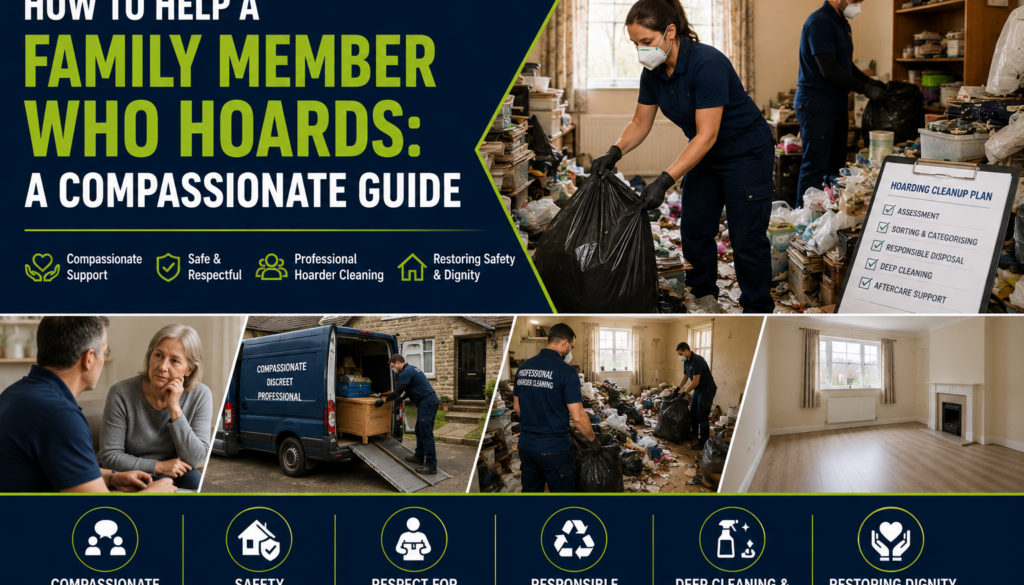
At Vamoose, a professional hoarder clean typically unfolds in the following stages:
- Initial consultation and assessment. A member of the team visits the property, assesses the level of hoarding, and has an honest, non-judgemental conversation about what the process will involve and what the goals are. This is not a rushed appraisal – it is the foundation of a working relationship.
- Planning with the individual where possible. Wherever the person is willing and able to be involved, they should be. Even small decisions – which room to start in, whether to keep a particular item – give back a sense of control that is important to the recovery process.
- Sorting, categorising, and responsible disposal. Items are sorted into categories: keep, donate, recycle, dispose. Nothing is thrown away arbitrarily. Anything with potential value is identified. Disposal is handled responsibly and legally.
- Deep cleaning and sanitisation. Once the space has been cleared, the property is deep cleaned to a professional standard – including areas that may have been inaccessible for years. This includes treating for pests where necessary.
- Aftercare and follow-up. The goal is not a single intervention. Sustainable change is built through ongoing support. Aftercare options and follow-up visits can be discussed at the consultation stage.
The aim throughout is to restore dignity and safety – not to strip a person of their environment. You can read more about our approach on our dedicated hoarders cleaning services page.
For properties where conditions have become extreme, our extreme cleaning service covers situations involving biohazards, severe contamination, and properties that require specialist equipment and trained crews.
Frequently Asked Questions
Q1: How do I know if a family member has a hoarding disorder?
The clearest indicators are a persistent difficulty discarding items regardless of their value, significant distress at the idea of getting rid of things, and accumulated clutter that has made parts of the home unusable or unsafe. If you have noticed that your loved one’s home has changed significantly over the years and they become defensive or distressed when the subject of their belongings is raised, it is worth taking those signs seriously. A GP can provide a formal assessment and referral.
Q2: What should I say to someone who hoards?
Lead with concern for their safety and wellbeing, not with judgements about the state of the property. Use ‘I’ statements: “I’ve been worried about you” rather than “You need to sort this out.” Acknowledge that their belongings feel important to them. Avoid ultimatums and do not push for immediate decisions. The first conversation is about opening a door, not walking through it. Be patient – it may take several conversations before they are ready to accept help.
Q3: Can I clean a hoarder’s house without their permission?
In most circumstances, no. If the person is a homeowner or tenant, they have legal rights over their property, and clearing it without consent could cause serious psychological harm and permanently damage your relationship. The exception is if there is an immediate risk to life or safety that requires emergency intervention – in which case, local authorities or environmental health officers may be involved. In all other situations, the priority should be supporting the person to reach a point where they are willing to accept help.
Q4: How much does professional hoarder cleaning cost in London?
The cost varies significantly depending on the level of hoarding, the size of the property, and the volume of waste requiring disposal. A Level 2 clean in a small flat will cost considerably less than a Level 4 or 5 clean in a multi-bedroom house. We will be publishing a full cost guide – Hoarders Cleaning Cost Guide UK 2026 – on 10 June 2026. In the meantime, the best way to get an accurate picture is to request a no-obligation quote from our team. We assess every job individually and will never give you a price before we understand what is actually involved.
Q5: How long does a professional hoarder clean take?
A Level 1 or 2 clean in a small property might be completed in a single day. A Level 4 or 5 clean in a large house may take several days across multiple visits. The speed of the process is also partly determined by how involved the person who hoards is able to be – a slower, more collaborative pace is sometimes more appropriate than the fastest possible clearance. At your initial consultation, we will give you a realistic timeline based on what we find.
Ready to Talk?
If you have reached the point of searching for help, that matters. It is not an easy step to take, and it often takes families a long time to get here.
At Vamoose, we work with families as well as with the individuals themselves. We understand that the person calling us is not always the person whose home needs support – and we are equally here for both.
If you would like a confidential, no-pressure conversation about how we can help, get in touch with our team today. There is no obligation, no judgement, and no rush. We are here when you are ready.
You can also request a quote online and we will come back to you promptly.
About the Author
Vamoose Cleaning Services is a professional cleaning company based in West London, specialising in hoarder cleaning, extreme cleaning, deep cleaning, end of tenancy cleaning, and after builders cleaning across London and the surrounding areas. The Vamoose team has extensive experience working with families, landlords, and local authorities on complex and sensitive cleaning situations, and is committed to delivering every job with discretion, professionalism, and genuine compassion.
Learn more about Vamoose | View all services