
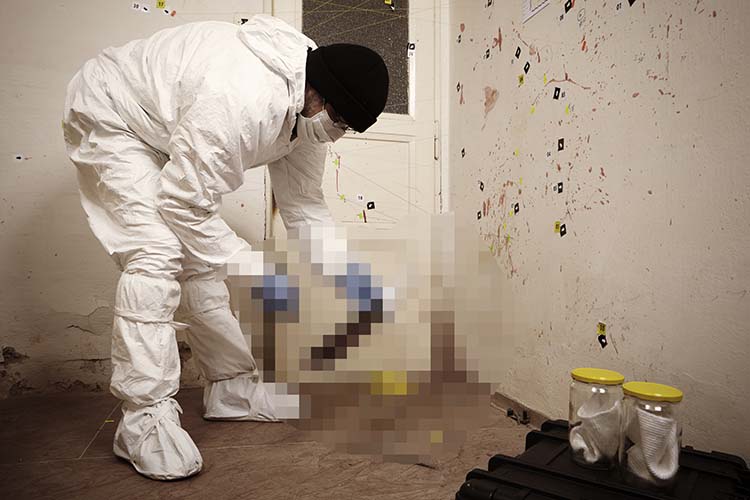
If you are asking how decomposition odours are removed from a property, the answer is that the smell cannot usually be solved with air freshener, carpet shampoo, paint, or ventilation alone. Effective removal requires locating every affected material, safely removing contamination, cleaning and disinfecting suitable surfaces, treating porous building materials, and only then using controlled air and odour treatment methods.
Decomposition odour is created by a complex mixture of volatile compounds released as biological tissue breaks down. Research into postmortem decomposition has identified a wide range of volatile organic compounds, with the exact odour profile changing according to temperature, time, environment, microbes, insects, and the condition of the remains.
This means the smell is not simply floating in the room. Fluids and odour producing compounds may have entered carpets, underlay, floorboards, concrete, furniture, wall materials, or other porous surfaces.
Until the source and affected materials are addressed, the odour may return even after the property has been aired out.
Vamoose Cleaning Services provides sensitive trauma cleaning services in London for families, landlords, housing providers, property managers, solicitors, and support organisations dealing with unattended deaths and other difficult incidents. Its current service information describes after death cleaning, contamination control, sanitation, odour treatment, and property restoration across London and surrounding areas.
Quick Answer: How Is Decomposition Odour Removed?
Professional decomposition odour removal normally involves the following stages:
- Confirming that the property has been released by the appropriate authority.
- Assessing the affected room and surrounding areas.
- Controlling access and preventing contamination from spreading.
- Identifying fluids, residues, insects, and affected materials.
- Removing porous items that cannot be safely restored.
- Cleaning and disinfecting suitable hard surfaces.
- Treating contaminated structural materials.
- Ventilating and filtering the air where appropriate.
- Applying targeted odour neutralisation after source removal.
- Inspecting the room again before it is returned for normal use.
The most important principle is simple:
The source must be removed before the smell can be reliably treated.
What Causes Decomposition Odour?
After death, natural biological processes begin breaking down tissues.
Bacteria and other microorganisms contribute to the release of gases and volatile compounds. These compounds create the persistent and recognisable smell associated with decomposition.
The odour may be affected by:
- The length of time before the person was found
- The temperature inside the property
- Heating and ventilation
- Humidity
- The position of the person
- The type of flooring
- The amount of fluid released
- Furniture or bedding beneath the person
- Insect activity
- Whether doors and windows were closed
- The size and layout of the room
A body discovered relatively quickly may still affect bedding, a mattress, flooring, or nearby furniture.
A longer period may allow fluids and odours to reach underlay, floorboards, concrete, plasterboard, skirting boards, or adjoining rooms.
This is why two properties that appear similar can require very different cleaning plans.
Why Does the Smell Remain After the Person Has Been Removed?
Removing the deceased does not automatically remove the contamination left inside the property.
Depending on the circumstances, biological material may remain on or beneath:
- Carpets
- Underlay
- Mattresses
- Sofas
- Wooden floors
- Laminate flooring
- Floorboards
- Concrete
- Tiles and grout
- Walls
- Skirting boards
- Furniture
- Bedding
- Clothing
- Curtains
- Personal belongings
Odour producing residues may also enter cracks, joints, gaps around pipes, floor edges, and other concealed spaces.
A room may smell slightly better after doors and windows are opened, but ventilation only reduces the concentration in the air temporarily. It does not remove contamination that has soaked into the property.
When the windows are closed or the room becomes warmer, the odour may become noticeable again.
What Should You Do Before Entering the Property?

Do not enter or disturb the affected room until the police, coroner, property owner, or other relevant authority has confirmed that access is permitted.
Where the discovery is recent and emergency services have not attended, do not move the person or clean the area. Call 999 if there is any possibility that the person may need urgent assistance.
Once the property has been released, unnecessary entry should still be avoided.
Keep the following people away from the affected area:
- Children
- Pets
- Residents
- Untrained cleaners
- Maintenance workers
- Contractors
- Estate agents
- Prospective tenants or buyers
- Visitors
The Health and Safety Executive advises organisations working around the deceased to assess infection hazards, reduce exposure, provide suitable protective measures, and establish safe working procedures. Its guidance is primarily written for occupations handling the deceased, but the same risk management principle is relevant when biological contamination remains in a property. Read the HSE guidance on managing infection risks when handling the deceased.
Why Should Families Avoid Cleaning the Area Themselves?
A decomposition clean is not an ordinary domestic cleaning task.
The visible stain may be only one part of the affected area. Fluids may have travelled underneath flooring or furniture where they cannot be seen.
Attempting to clean without the correct plan can:
- Spread contamination to other rooms
- Transfer residue onto shoes and clothing
- Push fluids further into flooring
- Expose the cleaner to biological material
- Damage items that may have been restorable
- Hide contamination under paint or flooring
- Make the eventual professional clean more difficult
- Cause emotional distress to relatives
Domestic masks, ordinary rubber gloves, household bleach, perfume sprays, and carpet cleaners are not a complete response to a decomposition scene.
Professional cleaners first assess the materials, contamination routes, waste requirements, and appropriate protective controls before deciding what can be cleaned and what needs to be removed.
How Are Decomposition Odours Removed From a Property Step by Step?
Step 1: Confirm That the Scene Can Be Entered
The cleaning company should confirm that the property has been released and that it is permitted to begin work.
The client may be:
- A family member
- An executor
- A probate solicitor
- A landlord
- A property manager
- A housing association
- A council
- An insurer
- A funeral professional
- Another authorised representative
The cleaner should also establish who can approve the removal of flooring, furniture, mattresses, or personal belongings.
No item should be assumed to be waste without appropriate authorisation.
Step 2: Complete an Initial Property Assessment
The team gathers information before work starts.
Questions may include:
- When was the person discovered?
- Which room is affected?
- Has the body been removed?
- Has the property been released?
- Is the property occupied?
- Are utilities available?
- Is there visible fluid or staining?
- Has anyone attempted cleaning?
- Is there insect activity?
- Are there pets in the property?
- Are there needles, medication, or other hazards?
- What type of flooring is present?
- Are neighbouring rooms affected by the smell?
- Is the property a flat with shared access?
- Is there suitable parking and waste access?
- Is an urgent deadline involved?
Photographs may help with preliminary planning, provided they can be taken safely and sensitively.
A site inspection may be required before a firm scope and price can be agreed.
Step 3: Restrict and Prepare the Work Area
The affected area should be separated from the rest of the property as far as reasonably possible.
The team may establish:
- A controlled route into the room
- A location for equipment
- A process for removing waste
- Measures to protect unaffected flooring
- Clean and contaminated working zones
- Procedures for removing protective equipment
- Ventilation controls
- Arrangements for shared hallways or entrances
In a London flat, this stage can be particularly important because the team may need to pass through communal corridors, staircases, lifts, or reception areas.
The aim is to complete the work discreetly while avoiding transfer of contaminated materials into unaffected spaces.
Step 4: Identify Every Affected Material
Visible staining is assessed first, but the inspection should extend beyond the obvious area.
The team may check:
- Carpet edges
- Underlay
- Floorboard joints
- Gaps beneath skirting
- Furniture legs and bases
- Mattress layers
- Sofa cushions
- Walls beside the affected area
- The underside of flooring
- Adjacent rooms
- Ceilings below an affected upstairs room
- Cracks in concrete
- Air vents
- Soft furnishings
- Stored belongings
Portable moisture or inspection tools may sometimes help identify areas that require further examination, but equipment should support professional judgement rather than replace it.
The room is assessed according to what actually happened, not according to a standard cleaning checklist.
Step 5: Remove Materials That Cannot Be Safely Restored
Porous materials may absorb biological fluids and odour producing compounds.
Items that cannot be effectively decontaminated may need controlled removal. These can include:
- Carpet
- Underlay
- Mattresses
- Upholstered furniture
- Bedding
- Clothing
- Soft furnishings
- Damaged laminate
- Contaminated floorboards
- Sections of plasterboard
- Heavily affected insulation
- Cardboard
- Paper products
- Unsealed timber
Removal decisions depend on the severity and depth of contamination.
A mattress with deep biological contamination cannot normally be restored by shampooing its surface. Similarly, a carpet may appear clean after extraction while contaminated underlay remains beneath it.
Waste from a decomposition clean should not simply be mixed with ordinary household rubbish. The waste stream, packaging, transport, and disposal route must be considered as part of the job.
Vamoose’s biohazard cleaning service in London includes support for affected waste, biological contamination, bodily fluids, surface decontamination, and odour treatment.
Step 6: Clean and Decontaminate Restorable Surfaces
Once heavily affected porous items have been removed, suitable surfaces are cleaned methodically.
The process may include:
- Removing visible organic residue.
- Cleaning dirt and biological material from the surface.
- Applying an appropriate disinfecting product according to its instructions.
- Respecting the required contact time.
- Repeating treatment where needed.
- Checking joints, edges, and surrounding fixtures.
- Allowing the area to dry properly.
Cleaning and disinfection are separate actions.
A disinfectant is less useful when a surface still contains heavy organic material. Physical cleaning must normally take place before the final disinfecting stage.
Products should be selected according to the surface and contamination involved. Cleaning chemicals should never be mixed unless the manufacturer expressly permits it, because certain combinations can release harmful gases or create dangerous reactions. HSE guidance warns that incompatible chemicals may react violently, generate heat, or produce toxic gases.
Step 7: Assess the Flooring and Subfloor
Floor contamination is one of the main reasons decomposition odours remain.
Carpet and Underlay
Carpet and underlay may need removal when fluids have penetrated beyond the surface.
Cleaning the upper carpet fibres does not resolve contamination beneath them.
Laminate Flooring
Fluid can travel between laminate joints and reach the underlay or subfloor.
Individual boards may need to be lifted to inspect the material below.
Timber and Floorboards
Unsealed wood can absorb fluids.
The affected section may need detailed treatment, sealing after decontamination, or replacement, depending on the depth and condition.
Concrete
Concrete appears solid but can be porous.
Surface cleaning may not be enough where contamination has penetrated. The treatment plan may involve repeated cleaning, controlled drying, specialist sealing, or removal of an affected surface layer.
Tiles and Grout
Tiles may be cleanable, but grout, adhesive, joints, and cracks should be assessed carefully.
The floor cannot be considered treated simply because the visible stain has disappeared.
Step 8: Check Walls, Skirting Boards, and Nearby Structures
Fluids may reach skirting boards, wall edges, furniture, or plasterboard.
If a wall material has absorbed contamination, painting over it is unlikely to solve the problem. Paint may temporarily reduce the smell but can trap the unresolved source beneath the coating.
Affected sections may need to be:
- Removed
- Cleaned
- Dried
- Treated
- Professionally sealed
- Replaced
The same principle applies to timber, cupboards, fixed furniture, and other structural materials.
The decision should be based on whether the material can realistically be decontaminated, not simply whether the stain can be hidden.
Step 9: Address Insects and Secondary Contamination
An unattended death may attract flies and other insects, particularly in warm conditions.
Insect activity can spread beyond the immediate location. Pupae or larvae may be found near:
- Windows
- Skirting boards
- Carpet edges
- Furniture
- Curtains
- Door frames
- Dark corners
- Adjacent rooms
Cleaning should therefore include inspection of the wider room.
A pest control specialist may be required where there is extensive activity. Pest treatment and cleaning should be coordinated so that neither service interferes with the other.
Step 10: Ventilate and Filter the Air
Once the physical contamination has been removed and the area cleaned, air management can support the remaining odour treatment.
Depending on the property, this may involve:
- Controlled ventilation
- Air movement
- Professional air filtration
- Adsorbent media
- Replacement of contaminated filters
- Temporary isolation of the affected room
- Monitoring of adjoining areas
Air treatment should not begin with the assumption that the room merely needs a stronger fragrance.
The purpose is to reduce remaining airborne compounds after the primary source has been addressed.
Step 11: Use Targeted Odour Neutralisation
Odour neutralisation is one of the final stages, not the first.
Professional products and equipment may be selected according to:
- The type of surface
- The source of the odour
- The room size
- Ventilation
- Remaining structural materials
- Whether the property is occupied
- The presence of children, pets, or vulnerable residents
- Manufacturer safety requirements
The aim is to treat remaining odour compounds rather than cover them with perfume.
Any strong deodorising treatment should follow a risk assessment and product instructions.
Is Ozone Used for Decomposition Odour Removal?
Ozone machines are sometimes promoted for severe odours, but ozone should never be treated as an easy alternative to removing contaminated materials.
The United States Environmental Protection Agency states that ozone is a lung irritant and that concentrations within public health limits are not effective at removing many odour causing chemicals. It also warns that ozone can react with other substances and create irritating or harmful byproducts. Read the EPA guidance on ozone generators sold as air cleaners.
Ozone should not be used casually in an occupied home.
Children, pets, residents, cleaners, neighbours, and building staff should never be exposed because someone has placed a consumer ozone machine in a room without suitable controls.
A reputable decomposition cleaning plan focuses first on source removal, physical cleaning, decontamination, drying, and material restoration.
Step 12: Complete a Final Inspection
The room should be inspected once it has dried and settled.
The final review may consider:
- Whether any odour remains
- Whether hidden areas were checked
- Whether the subfloor needs more treatment
- Whether building materials need sealing or replacement
- Whether waste has been removed
- Whether insect activity remains
- Whether adjoining rooms are affected
- Whether the area is ready for contractors
- Whether flooring or walls can be reinstated
- Whether the property needs further ventilation
A quick smell check immediately after applying a deodoriser is not enough.
Strong cleaning products can temporarily mask remaining decomposition odour. The room should be reviewed after those fragrances have reduced.
What Does Not Remove Decomposition Odour Properly?

Air Fresheners
Air fresheners mix fragrance with the existing smell.
They do not remove biological contamination and may make the room harder to assess.
Opening Windows Alone
Ventilation may make the air feel better temporarily, but the smell can return once the room is closed or heated.
Household Bleach Alone
Bleach is not a complete decomposition cleaning method.
It does not automatically penetrate contaminated carpet, timber, concrete, furniture, underlay, or wall materials.
It can also damage surfaces and react dangerously with other chemicals.
Carpet Shampoo
Carpet cleaning may spread moisture through contaminated layers.
Where biological material has entered the underlay, cleaning only the surface is unlikely to provide a reliable result.
Painting Over the Area
Paint may hide staining and temporarily reduce smell.
If the source remains underneath, the odour may return and building materials may continue to be affected.
Burning Candles or Incense
Fragrance and smoke may cover the smell briefly but do not clean the property.
Open flames may also create an unnecessary fire risk.
Placing Bowls of Vinegar or Baking Soda
These household approaches may help with minor everyday smells, but they are not substitutes for biohazard removal, structural cleaning, or decontamination.
Using a Consumer Ozone Machine
Improper use can expose people to an irritant without addressing the contaminated source. Ozone equipment should not be placed in an occupied room as a do it yourself shortcut.
Can Everything in the Room Be Saved?
Not always.
Whether an item can be restored depends on:
- The material
- The level of contact
- The amount of fluid
- How long it remained contaminated
- Its construction
- Its financial or sentimental value
- Whether effective cleaning is possible
- Whether cleaning would create further exposure
Hard, sealed, nonporous items may be easier to clean than absorbent belongings.
Important documents, photographs, jewellery, and sentimental objects should be discussed before disposal. Where safe restoration is possible, they may be separated for specialist handling.
Heavily contaminated mattresses, soft furniture, carpets, and low value porous items are less likely to be suitable for restoration.
The authorised client should make final decisions with professional guidance.
How Long Does Decomposition Odour Removal Take?
There is no fixed timeframe.
A small affected area discovered quickly may require less time than a property where contamination has entered flooring, furniture, walls, or several rooms.
The duration can be influenced by:
- The time before discovery
- Property size
- Room temperature
- Amount of biological material
- Type of flooring
- Number of affected contents
- Waste volume
- Building access
- Parking restrictions
- Drying time
- Pest activity
- Structural removal
- Replacement work
- Whether the property is occupied
- Whether emergency access is needed
Some projects may be completed in one working visit. More complex properties may require several stages, including material removal, treatment, drying, odour review, and reinstatement.
How Much Does Decomposition Cleaning Cost?
The cost is based on the property and work required rather than one standard price.
Factors may include:
- Size of the affected area
- Number of rooms
- Level of contamination
- Time before discovery
- Type of flooring
- Waste disposal
- Furniture removal
- Subfloor treatment
- Wall or ceiling treatment
- Odour control requirements
- Pest concerns
- Team size
- Protective equipment
- Access and parking
- Urgency
- Evening or weekend work
- Further restoration needs
A reliable estimate normally requires clear information, photographs, or a site assessment.
Be cautious of a quote based only on the number of bedrooms. Decomposition cleaning is determined by contamination, materials, access, and the depth of restoration needed.
Does Insurance Cover Decomposition Cleaning?
Some home, landlord, property, or specialist insurance policies may contribute to the cost, but cover varies significantly.
The policyholder should contact the insurer before authorising extensive removal where possible.
The insurer may ask for:
- The incident date
- Police or coroner information
- Photographs
- A professional quotation
- A cleaning report
- Waste documentation
- A list of removed items
- Evidence of property damage
Do not delay urgent safety measures solely because an insurer has not responded. Ask the insurer what immediate action is permitted and keep records of communication.
Who Usually Arranges the Cleaning?
Decomposition odour removal may be arranged by:
- The deceased person’s family
- An executor
- A probate solicitor
- A landlord
- A letting agent
- A property manager
- A housing association
- A council
- An insurer
- A funeral home
- A police liaison contact
- A support organisation
The person arranging the service should identify who has legal or practical authority to approve entry, disposal, and property alterations.
Decomposition Cleaning in Flats and Shared Buildings
A decomposition incident in a London flat may affect more than the room itself.
Odour can become noticeable in:
- Shared corridors
- Staircases
- Lift areas
- Neighbouring flats
- Ventilation routes
- Entrance halls
- Rooms beneath the affected floor
The property manager, freeholder, housing officer, or managing agent may need to be informed where communal areas are affected.
The cleaning team may also need to plan:
- Discreet equipment transport
- Lift protection
- Controlled waste removal
- Parking
- Entry codes
- Resident communication
- Communal ventilation
- Access outside busy periods
Client confidentiality should still be respected. Neighbours do not need unnecessary personal details about the incident.
Supporting Families During a Difficult Situation
An unattended death can be distressing and overwhelming.
Relatives may be dealing with grief, police communication, funeral arrangements, probate, housing concerns, personal belongings, and insurance at the same time.
They should not be pressured to view or clean an affected room.
A specialist team should communicate calmly and explain:
- What information is needed
- Which areas are affected
- What can be cleaned
- What may need removal
- Who must authorise disposal
- How long the process may take
- What will happen next
Vamoose states that its trauma service is designed around privacy, respectful handling, after death cleaning, bodily fluid sanitation, odour treatment, and structured property restoration.
Emergency Decomposition Cleaning
Quick action can help limit further property damage, especially in warm conditions or where fluids are continuing to affect porous materials.
Urgent support may be needed when:
- A landlord needs to protect neighbouring properties
- A family cannot safely enter
- A housing provider needs to secure the building
- Communal areas are affected
- The smell is spreading
- Contractors need access
- A probate property must be assessed
- There is visible biological contamination
- Pest activity is increasing
Vamoose offers emergency cleaning services in London for urgent odour, contamination, waste, and heavily soiled property situations, subject to availability and assessment.
Local Decomposition Odour Removal Across London
Vamoose Cleaning Services is based in Ruislip, Middlesex, and supports specialist cleaning enquiries across London and surrounding areas.
This includes locations such as:
- Ruislip
- Uxbridge
- Hillingdon
- Harrow
- Ealing
- Hounslow
- Brent
- Watford
- West London
- North West London
- Central London
- Middlesex
- Surrey
- Sussex
- Surrounding counties
Its current specialist service pages also state that trauma and biohazard support is available across London, Watford, Middlesex, Surrey, Hertfordshire, Buckinghamshire, and nearby areas.
Providing the full postcode early helps the team plan travel, parking, building entry, waste removal, and any access restrictions.
Information to Provide When Requesting a Quote
Share what you safely know:
- Property postcode
- Property type
- Affected room
- Approximate discovery date
- Confirmation that the scene has been released
- Type of flooring
- Visible staining
- Furniture or bedding involved
- Pest activity
- Number of affected rooms
- Whether the property is occupied
- Access arrangements
- Parking restrictions
- Required completion date
- Contact details for the authorised decision maker
You do not need to enter the affected area to gather extra information.
Frequently Asked Questions
How are decomposition odours removed from a house?
The source and affected porous materials must first be identified and removed where necessary. Restorable surfaces are then cleaned and disinfected, structural materials are treated, and controlled air or odour treatment is used after decontamination.
Will the smell disappear when the body is removed?
Not necessarily. Biological fluids and odour compounds may remain in carpets, underlay, furniture, floorboards, concrete, walls, and other materials after the body has been taken away.
Can ordinary cleaners remove decomposition odour?
A routine cleaner may not have the training, equipment, insurance, waste procedures, or protective controls required for an unattended death scene. A specialist trauma or biohazard cleaning service is more appropriate.
Can bleach remove decomposition smell?
Bleach alone is not a reliable solution. It cannot remove contaminated carpet, underlay, wood, concrete, furniture, or structural material, and it can be dangerous if mixed with other chemicals.
Does the carpet always need to be removed?
Not in every situation, but carpet and underlay commonly require removal when biological fluids have penetrated them. The decision depends on the location and depth of contamination.
Can decomposition fluid soak through a floor?
Yes. Fluids may pass through carpet, underlay, laminate joints, floorboards, cracks, or gaps and reach the subfloor or room below.
Can decomposition odour enter the walls?
Odour and contamination may affect skirting boards, wall edges, plasterboard, insulation, or nearby fixtures depending on the location and extent of the incident.
Can air freshener or ozone remove the smell?
Air freshener only masks odour. Ozone is not a substitute for source removal and should not be used casually in an occupied property because it can irritate the lungs and react with indoor chemicals.
How long does the cleaning take?
The work may take from several hours to several days depending on the affected area, flooring, waste, structural contamination, drying needs, and whether materials need removal.
How soon should decomposition cleaning begin?
The cleaning should be arranged after the relevant authority has released the property. Early assessment can help prevent further absorption into porous materials and reduce delays in restoring the room.
Can the property be lived in during the cleaning?
This depends on the affected area, property layout, odour, contamination level, and cleaning method. The specialist team should assess whether temporary absence or restricted access is required.
Can personal belongings be saved?
Some sealed or nonporous items may be suitable for cleaning. Heavily contaminated porous belongings may need removal. Important or sentimental items should be discussed before disposal.
Who pays for unattended death cleaning?
The family, estate, landlord, insurer, housing provider, or another responsible organisation may cover the cost depending on ownership, policy terms, and the circumstances.
Do you provide decomposition cleaning near Ruislip?
Vamoose handles trauma, biohazard, after death, and odour related cleaning enquiries from Ruislip and across London, Middlesex, Surrey, Sussex, Watford, and surrounding areas.
Arrange a Sensitive Property Assessment
Decomposition odour will continue to return when contaminated materials remain inside the property.
The safest next step is to arrange a specialist assessment after the relevant authority has released the scene. Explain which room is affected, when the person was discovered, the property location, the type of flooring, and whether visible fluids, pests, or strong odours remain.
Call 01895 717 115 to discuss decomposition cleaning, trauma cleaning, biohazard decontamination, or urgent odour removal across London and surrounding areas.
You can also view Vamoose Cleaning Services on Google for business information and customer reviews.