
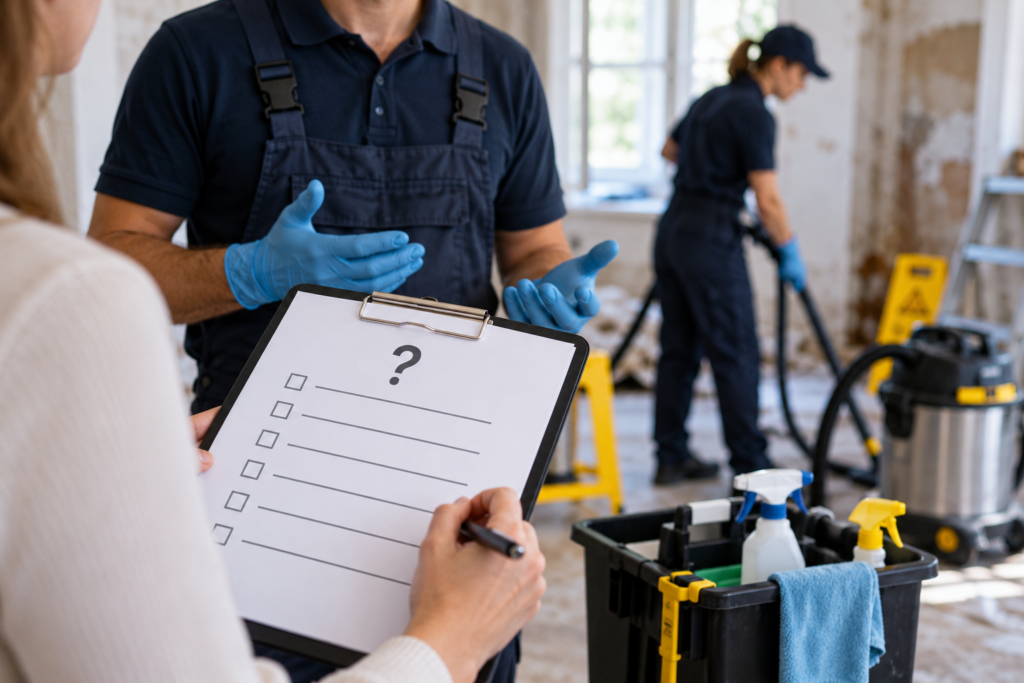
Hiring a specialist cleaning company can feel like a big decision, especially when a property needs more than an ordinary clean. Severe dirt, hoarding, biohazard contamination, trauma incidents or long term neglect can require specialist equipment, trained professionals and carefully planned cleaning procedures.
Choosing a company based only on price or a quick online search may leave important questions unanswered. You need to know whether the team has experience with your situation, understands the risks, carries appropriate insurance and can explain exactly what the service will involve.
For homeowners, landlords, letting agents, housing associations and property managers, asking the right questions before booking can help prevent misunderstandings and make the process less stressful.
Vamoose Cleaning Services provides specialist cleaning support for challenging property conditions across London and surrounding areas. This guide explains the most important questions to ask before hiring a specialist cleaning company, what reassuring answers look like and which warning signs deserve attention.
What Is a Specialist Cleaning Company?
A specialist cleaning company handles situations that may require more expertise, equipment or safety precautions than routine domestic cleaning.
Depending on the provider, services may include:
- Specialist deep cleaning for heavily soiled properties.
- Hoarder cleaning and property clearance.
- Biohazard cleaning and decontamination.
- Trauma scene cleaning following distressing incidents.
- Neglected property cleaning.
- Extreme cleaning for properties affected by significant dirt, waste or hygiene problems.
- Emergency cleaning for urgent property conditions.
These services are not interchangeable. A company experienced in ordinary house cleaning may not have the equipment, training or procedures required to handle biological contamination or extensive waste safely.
The first step is to identify what your property needs and find a provider with relevant experience.
1. What Specialist Cleaning Services Do You Provide?
Start by asking whether the company has experience with the specific cleaning problem you need to resolve.
A provider might offer deep cleaning but not biohazard decontamination. Another may handle hoarder cleaning and waste removal but not every type of trauma related cleaning.
Explain the condition of the property and ask the company to confirm which service is appropriate.
For example, a landlord preparing a neglected rental property for new tenants may need clearance, deep cleaning and odour treatment. A property affected by bodily fluids may require a specialist biohazard cleaning process instead.
A reputable company should explain what it can handle, what falls outside its service and whether another professional may be needed.
What to look for: A clear explanation of the service that matches your circumstances rather than a promise that every problem can be solved with a standard clean.
2. Do You Have Experience with Similar Cleaning Projects?
Experience matters because every property presents different challenges.
A severely neglected home may contain accumulated waste, blocked access routes, persistent odours or surfaces that need careful treatment. A biohazard cleaning project may involve contamination risks that ordinary cleaning methods cannot address safely.
Ask the company:
- Have you handled properties with similar conditions?
- What challenges are likely to affect this project?
- How would you plan the work?
- Can you provide relevant examples or case studies without revealing previous clients’ private information?
- What could prevent the expected result from being achieved?
A professional provider should explain its approach without making unrealistic promises before assessing the property.
For instance, removing a persistent odour may require identifying and treating its source. Simply applying a fragrance or cleaning the visible surface may not solve the underlying problem.
What to look for: Relevant experience, realistic expectations and a clear explanation of the proposed approach.
3. Are You Fully Insured?
Insurance is an important consideration whenever a company works inside a home, rental property or commercial building.
Ask what insurance the company holds and whether the cover applies to the type of work you need.
Public liability insurance can help cover certain claims involving accidental injury or property damage, subject to the policy terms. If the company employs staff, employers’ liability insurance may also be legally required, subject to applicable exemptions.
You can ask to see current insurance documentation and check:
- The policy expiry date.
- The type of work covered.
- Any relevant exclusions.
- Whether the cover applies to the property and circumstances involved.
Do not assume that every policy covers every specialist cleaning activity. A company handling hazardous contamination should confirm that its insurance is suitable for the work being undertaken.
What to look for: Clear answers about the scope of insurance and a willingness to provide appropriate evidence.
4. Are Your Staff Trained for This Type of Cleaning?
Specialist cleaning may involve risks that require specific training and procedures.
Ask how staff are trained to handle the type of property or contamination involved. Depending on the project, relevant knowledge may include safe chemical handling, risk assessment, appropriate protective equipment, contamination control and waste handling.
For example, a team working in a property affected by biological contamination should understand how to prevent cross contamination and select appropriate cleaning and disinfection procedures.
You can also ask who supervises the work and how the company checks that its procedures are followed.
Not every cleaning task requires the same qualification, so focus on training that is relevant to your particular situation.
What to look for: A clear explanation of relevant training, supervision and safety procedures rather than vague claims of expertise.
5. Do You Carry Out a Risk Assessment Before Starting?
A proper assessment helps the cleaning team understand the property before deciding how to approach the work.
Ask whether the company will assess the condition of the property, identify potential hazards and prepare a suitable plan before cleaning begins.
Depending on the circumstances, the assessment may consider:
- The level and type of contamination.
- Access routes and any structural concerns.
- The need for protective equipment.
- Items that must be retained or removed.
- Waste disposal requirements.
- Areas requiring special treatment.
- Whether occupants, pets or other workers should remain away from the affected area.
A property with severe hoarding, for example, may have unstable piles of belongings, obstructed exits or hidden hazards. Starting work without considering these risks can create additional problems.
Vamoose describes carrying out risk assessments and preparing a project plan before starting cleaning work.
What to look for: A structured assessment and a clear explanation of how identified risks will affect the cleaning plan.
6. How Will You Handle Hazardous Materials and Waste Disposal?
This question is particularly important for biohazard cleaning, hoarder clearance and properties containing potentially dangerous waste.
Not all waste can be handled or disposed of in the same way. Certain materials may require specialist packaging, handling, transport or disposal arrangements.
Ask the company:
- What types of waste do you expect to remove?
- How will you determine whether specialist handling is necessary?
- Who will transport and dispose of the waste?
- Will the waste be taken to an appropriate authorised facility?
- What documentation will be provided where required?
- Are waste removal costs included in the quotation?
A company should be able to explain its approach and identify when additional specialist arrangements may be needed.
Where regulated waste is involved, check that the relevant legal requirements are followed. In England, you can use the Environment Agency’s waste carrier registration service to check registration requirements and relevant registrations.
What to look for: A documented, lawful waste management process and transparent pricing for clearance and disposal.
7. Do You Carry Out DBS Checks on Staff?
A Disclosure and Barring Service (DBS) check may be relevant when cleaning staff enter private homes or work in sensitive circumstances.
Ask whether staff undergo appropriate background checks and what level of check is used.
However, DBS checks are not a universal legal requirement for every cleaning role. The level of check available depends on the role and the relevant eligibility rules.
A background check should be considered alongside other safeguards, including staff supervision, identity verification, references and company procedures.
If the work involves a vulnerable person or a sensitive property situation, ask how the company protects the people involved and maintains appropriate professional boundaries.
What to look for: A clear explanation of staff vetting that is accurate about the checks undertaken and their limitations.
8. How Do You Protect My Privacy and Confidentiality?
Specialist cleaning is sometimes required during difficult personal circumstances, such as hoarding, a bereavement, a trauma incident or a serious property hygiene problem.
You may not want neighbours, tenants or other people to know the details of the situation.
Ask the company how it handles private information and whether its staff follow confidentiality procedures.
Useful questions include:
- Who will receive information about the property?
- Are photographs taken during the assessment or cleaning?
- How are photographs and customer details stored?
- Will the team use discreet communication and arrival arrangements where practical?
- Will photographs or details ever be used for marketing without appropriate permission?
A professional provider should discuss privacy respectfully and explain how it handles information. It should also be clear about any limits to confidentiality where legal obligations apply.
Vamoose states that it handles specialist cleaning enquiries with discretion and respect.
What to look for: A respectful conversation, clear privacy practices and no pressure to share unnecessary personal details.
9. What Exactly Is Included in the Cleaning Service?
A quotation should explain the work being offered rather than simply describing it as a deep clean or specialist clean.
Ask for a written scope of work that identifies the areas to be cleaned, the tasks included and any exclusions.
Depending on the project, the scope may cover:
- Removal of agreed waste and unwanted items.
- Cleaning of accessible floors, walls and surfaces.
- Cleaning and disinfection of affected areas.
- Treatment of persistent odours where included.
- Cleaning of kitchens, bathrooms or other priority areas.
- Special handling of identified materials.
- A final inspection of the agreed work.
- Documentation or photographs, where agreed.
Do not assume that clearance, repairs, pest control, mould remediation or replacement of damaged materials are automatically included in a cleaning quotation.
For example, a property owner may expect a quotation to include furniture removal, but the company may have priced only the cleaning work. Clarifying this before booking can prevent unexpected costs.
What to look for: A written list of deliverables, exclusions and any additional services that may be needed.
10. Will You Provide a Written Quotation and Explain All Costs?
The cheapest initial quotation is not always the best value.
A specialist cleaning project may involve labour, equipment, protective materials, waste disposal, additional visits and treatments that cannot be estimated accurately without understanding the property.
Ask the company to explain:
- The total estimated cost.
- Whether the price is fixed or subject to change.
- What is included in the price.
- Whether waste disposal or specialist materials cost extra.
- How additional work will be priced.
- Whether VAT applies.
- What deposit or payment arrangements are required.
- How changes to the scope will be approved.
A written quotation should make it clear what you are paying for. If the company discovers an unexpected problem during the work, it should explain the implications before proceeding with additional chargeable tasks, subject to any agreed emergency arrangements.
What to look for: Transparent pricing, written terms and a clear process for approving additional work.
11. How Long Will the Cleaning Take?
The time required depends on the size of the property, the severity of the conditions, the number of staff involved and the type of work needed.
A straightforward deep clean may be completed in a single visit, while a heavily neglected property or complex biohazard project may require more time.
Ask the company:
- When can the assessment take place?
- What is the expected start date?
- How long is the work likely to take?
- Will the team need access over multiple days?
- Could unexpected findings delay completion?
- Will anyone need to stay away from the property during the work?
A professional provider should offer a realistic estimate and explain which factors may affect the schedule.
Be cautious of guaranteed completion times given before the company understands the property’s condition.
What to look for: A realistic timetable, clear communication and an explanation of possible delays.
12. What Cleaning Products and Equipment Will You Use?
The products and equipment needed depend on the type of cleaning and the materials being treated.
Specialist cleaning may require professional equipment, suitable cleaning agents, protective equipment and specific disinfection procedures. Using an unsuitable product can damage surfaces or fail to address the actual problem.
Ask whether the company will:
- Select products suitable for the affected materials.
- Follow the relevant product instructions.
- Use appropriate protective equipment.
- Explain any access restrictions or ventilation requirements.
- Consider pets, children, allergies or other relevant sensitivities.
- Use specialist equipment where necessary.
If the property contains suspected asbestos, structural damage or another hazard outside the cleaning team’s competence, ask how the company will handle the situation before work continues.
What to look for: A method that matches the identified risk and property condition, rather than a one product fits all approach.
13. How Will You Check the Quality of the Finished Work?
A clear completion process helps both parties understand whether the agreed work has been carried out.
Ask whether the team will inspect the cleaned areas and explain how any concerns will be addressed.
You may wish to confirm:
- Whether a final walkthrough is available.
- Which areas will be checked.
- Whether photographs or a completion report can be provided.
- How to report a missed task.
- Whether any follow up visit is included.
- What happens if the agreed scope has not been completed.
For landlords and property managers, written records can be particularly useful when preparing a property for new occupants or reporting work to a client.
Remember that cleaning cannot always restore a damaged surface or remove every permanent stain. A good company should explain these limitations before the work begins.
What to look for: A defined inspection process and a clear way to resolve issues against the agreed scope.
14. Can You Provide References or Relevant Case Studies?
References and case studies can help you assess whether a company has handled similar projects.
Ask for examples relevant to your situation, such as neglected property cleaning, hoarder clearance or biohazard decontamination.
When reviewing examples, consider:
- Whether the project resembles your own.
- How clearly the company explains the work undertaken.
- Whether the limitations and outcome are described realistically.
- Whether the example is recent enough to be useful.
- Whether photographs have been shared appropriately and with permission.
Online reviews can also help you understand communication, reliability and customer experience. Read a range of reviews rather than relying entirely on a single rating.
Vamoose has a Google Business Profile where you can review its business information and customer feedback.
What to look for: Relevant evidence of experience and consistent professionalism, while remembering that no reference can guarantee the result of your particular project.
15. What Happens If the Property Needs More Work Than Expected?
The condition of a property can be difficult to assess fully before items are moved or concealed areas become accessible.
Ask how the company handles unexpected discoveries, such as additional waste, hidden contamination, inaccessible rooms or damage that needs a separate specialist.
A suitable process should explain:
- How the team will communicate the finding.
- Whether work will pause in the affected area.
- Whether a revised risk assessment is needed.
- Whether the price or schedule will change.
- Whether your approval is required before additional work begins.
- When another specialist may be necessary.
For example, a cleaning team may discover that a floor covering is contaminated beneath furniture or that a persistent smell comes from a source not included in the original scope.
It is better to agree on a process for unexpected problems than to rely on a promise that the entire job will always be completed at the original price.
What to look for: Honest communication, appropriate safety decisions and an agreed process for changes.
16. Do You Offer a Free Assessment or Estimate?
An initial conversation or assessment can help the company understand the job and recommend an appropriate service.
Ask whether the assessment is free, whether a site visit is required and what information the company needs from you.
You may be asked about:
- The property type and approximate size.
- Which rooms or areas are affected.
- The general condition of the property.
- Whether hazardous materials or contamination are suspected.
- The urgency of the work.
- Access, parking and waste removal requirements.
- Your priorities and any items that must be retained.
A photograph or video call may help with an initial discussion, but it will not always replace a site assessment. For complex or potentially hazardous situations, the company may need to inspect the property before confirming the work plan.
Vamoose offers estimates and explains that the appropriate service depends on the property’s condition and cleaning requirements.
What to look for: A clear assessment process and an estimate based on the information needed to understand the work.
How to Compare Specialist Cleaning Companies
Once you have asked your questions, compare the answers rather than simply comparing the quoted prices.
| What to compare | What a strong response looks like |
| Relevant experience | Evidence of similar projects and an appropriate method |
| Insurance | Clear details and suitable documentation |
| Training and safety | Relevant training, risk assessment and supervision |
| Waste management | Clear handling and disposal arrangements |
| Privacy | Respectful communication and defined confidentiality practices |
| Scope of work | Written inclusions, exclusions and deliverables |
| Pricing | Transparent quotation and a process for extra work |
| Timescale | Realistic schedule with clear updates |
| Quality checks | Agreed inspection and issue resolution process |
| Communication | Prompt, clear and respectful responses |
| A company does not need to use the most impressive marketing language to be a good choice. Look for clear evidence that it understands the work, communicates honestly and can explain how the project will be managed. |
Warning Signs to Watch for Before Booking
Some warning signs deserve closer attention before you commit.
Vague answers about specialist experience
If the company cannot explain how it will handle your particular situation, ask for more information or consider another provider.
No clear information about insurance
A company should be able to explain its cover and provide appropriate evidence. Do not rely on a general statement that it is fully insured without checking whether the policy suits the work.
Pressure to pay before the work is explained
Understand the quotation, deposit arrangements and cancellation terms before making a payment. Be cautious if you are pressured to commit immediately without enough information.
Unclear waste disposal arrangements
Where waste or potentially hazardous materials are involved, the company should explain how these will be handled and disposed of lawfully.
Unrealistic promises
Claims that every stain, smell or damaged surface can be completely restored should be treated carefully. Results depend on the condition of the property and the underlying cause of the problem.
No written scope of work
A written agreement helps prevent misunderstandings about which areas, tasks and additional services are included.
One warning sign does not necessarily prove that a company is unsuitable, but repeated vague or contradictory answers should prompt you to reconsider.
Why Choose Vamoose Cleaning Services?
Vamoose Cleaning Services provides specialist cleaning support for properties that require more than routine domestic cleaning.
Its services include deep cleaning, extreme cleaning, hoarder cleaning, neglected property cleaning, biohazard cleaning and trauma cleaning.
The company describes its approach as structured, discreet and tailored to the condition of each property. Its published information also states that it carries out risk assessments and prepares project plans before starting work.
Vamoose supports homeowners, landlords, letting agents, housing organisations and other clients who need practical help with challenging property conditions.
If you are dealing with a property that has accumulated significant dirt, waste, persistent odours or contamination, the first step is to explain the situation and discuss the appropriate service.
You can explore the company’s specialist cleaning services to understand the available options.
For specific needs, you can also learn more about biohazard cleaning or hoarders cleaning.
Before booking, ask the team about the assessment process, proposed work, expected timescale and costs. This gives you an opportunity to understand what is involved and decide whether the service meets your needs.
Frequently Asked Questions
What should I ask before hiring a specialist cleaning company?
Ask about relevant experience, insurance, staff training, risk assessments, waste disposal, confidentiality, pricing and the exact scope of work. You should also clarify the expected timescale and how the finished work will be checked.
How do I know whether I need specialist cleaning?
Specialist cleaning may be appropriate when a property has severe dirt, extensive clutter, significant waste, persistent odours, suspected biological contamination or other conditions that require additional expertise and safety precautions. A professional assessment can help identify the right service.
Should a specialist cleaning company provide a written quotation?
Yes, a written quotation is advisable. It should explain the work included, exclusions, estimated cost, payment terms and how additional work will be approved.
Is specialist cleaning confidential?
A professional company should explain how it protects customer information and handles sensitive situations. Ask who will access your information, how photographs are used and whether any limits to confidentiality apply.
Do specialist cleaners need DBS checks?
DBS checks may be relevant depending on the role and working arrangements, but they are not a universal legal requirement for all cleaning staff. Ask which checks are carried out and what other safeguards the company uses.
How much does specialist cleaning cost?
The cost depends on the property’s size, condition, type of cleaning, labour, equipment, waste disposal and any additional treatments required. Request a written estimate based on the actual circumstances rather than relying on a general price.
Can a specialist cleaning company remove hazardous waste?
Some specialist providers handle particular types of hazardous or regulated waste, subject to their competence, authorisations and legal requirements. Ask how the waste will be handled, transported and disposed of, and whether another specialist is required.
How long does specialist cleaning take?
A straightforward job may take a few hours, while a severely neglected property or complex contamination project may require several visits or days of work. The provider should explain the expected schedule after assessing the situation.
Will I need to leave the property during cleaning?
It depends on the work and the risks involved. For some projects, remaining elsewhere may be advisable or necessary while the team works. Ask the company to explain access restrictions and when the area can safely be used again.
Does Vamoose Cleaning Services provide estimates?
Vamoose offers estimates for specialist cleaning work. You can contact the team with details about the property, its condition and your requirements to discuss the appropriate next step.
Final Thoughts
Hiring a specialist cleaning company is about more than finding someone who can make a property look cleaner. The right provider should understand the problem, assess the risks, explain the work, handle waste appropriately and treat the people involved with respect.
Asking these questions before booking helps you compare companies on experience, safety, transparency and service quality. It also gives you a clearer understanding of what the work will involve and what the final result can reasonably achieve.
If you need specialist cleaning support for a neglected property, hoarding situation, biohazard concern or another challenging cleaning problem, Vamoose Cleaning Services can discuss your requirements and explain the available options.