
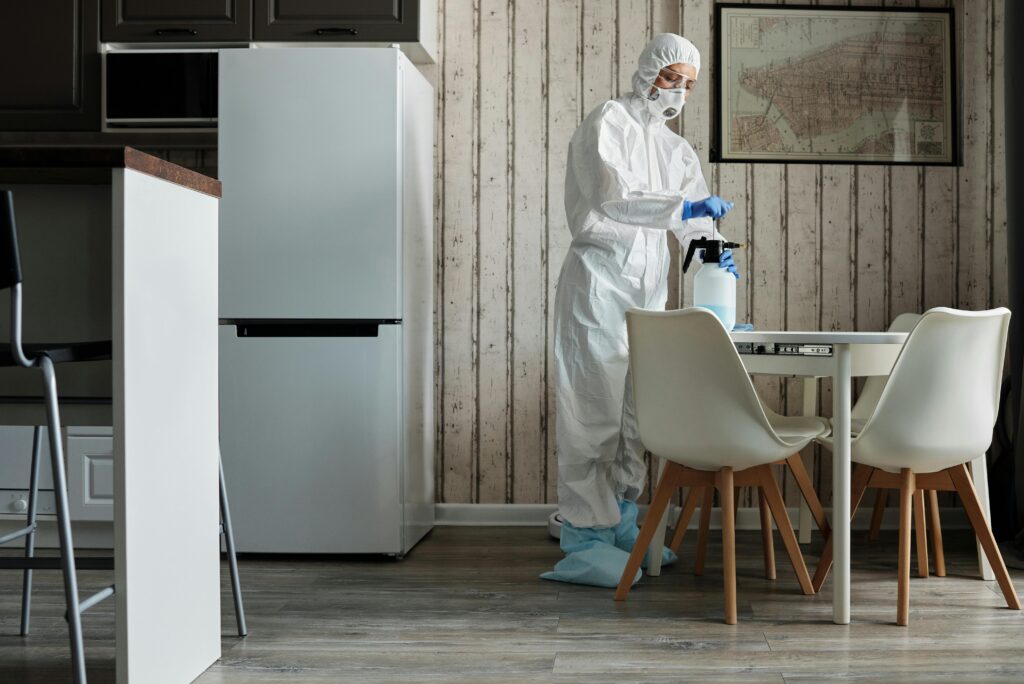
If you find needles or sharps in a property, do not touch, move, cover, bend, recap, or dispose of them yourself. Keep people and animals away from the area, prevent anyone from continuing to clean or clear the property, and arrange removal through the responsible property manager, local authority where applicable, or a trained sharps removal company.
A discarded needle may look easy to pick up, especially when it is lying in an empty room, garden, hallway, bin area, or neglected property. However, attempting to remove it without the correct equipment can expose you, cleaners, contractors, residents, children, and pets to a puncture injury.
The safest response is to pause the work, isolate the area, record where the item was seen from a safe distance, and arrange an appropriate needle sweep and controlled removal.
Vamoose Cleaning Services supports homeowners, landlords, housing associations, councils, estate agents, support teams, and property managers across London, Ruislip, Middlesex, Surrey, Sussex, and surrounding areas when needles, syringes, or other hazardous sharps are discovered inside a property.
Quick Answer: What Should You Do First?
Take the following immediate steps:
- Stop moving through or cleaning the affected area.
- Do not touch the sharp, even while wearing ordinary gloves.
- Keep children, residents, contractors, visitors, and pets away.
- Close the room or restrict access where this can be done without approaching the item.
- Record the location from a safe distance.
- Inform the landlord, property manager, housing officer, or responsible organisation.
- Arrange trained collection or a professional needle sweep.
- Seek urgent medical advice if anyone has been cut or punctured.
The Health and Safety Executive states that blood contaminated sharps can transmit blood borne viruses through an injury. Its guidance advises that discarded needles should not be handled casually and that suitable equipment, training, and sharps containers are required for controlled removal.
What Counts as a Needle or Sharp?
The word “sharps” covers more than complete syringes.
Items that may require controlled handling include:
- Hypodermic needles
- Syringes with attached needles
- Loose needle tips
- Lancets
- Insulin pen needles
- Scalpel blades
- Razor blades
- Tattoo needles
- Piercing equipment
- Broken medical glass
- Contaminated fragments with sharp edges
- Drug related equipment that could puncture the skin
An item does not have to look visibly contaminated to present a risk. A needle may be damaged, concealed, rusty, partially covered, or separated from the syringe.
Never inspect the point closely, attempt to identify what was inside the syringe, or pick the item up to photograph it.
Why Should Discarded Needles Be Treated Carefully?
The main immediate risk is a puncture or cut.
If a sharp has been contaminated with blood, an injury may create a route through which infection can be transmitted. The actual level of risk depends on several factors, including the type of sharp, whether it was contaminated, the depth of injury, and how long it has been in the environment.
The Health and Safety Executive identifies hepatitis B, hepatitis C, and HIV among the blood borne viruses that can potentially be transmitted through an injury involving infected blood. This does not mean that every discarded needle carries an infection. It means that the risk should be assessed by a healthcare professional rather than dismissed based on appearance.
Needles can also create secondary risks when they are:
- Hidden under clothing, papers, or rubbish
- Mixed into ordinary household waste
- Left inside sofas, beds, or mattresses
- Concealed in carpets or floor coverings
- Placed inside bottles, bags, or food containers
- Scattered through gardens, sheds, stairwells, or communal spaces
- Mixed with bodily fluids, drug equipment, or other contamination
This is why finding one needle may justify checking the surrounding area before normal cleaning or clearance continues.
What to Do If You Find Needles or Sharps in a Property
1. Stop Work Immediately
Do not continue vacuuming, sweeping, moving furniture, sorting rubbish, or clearing bags around the location.
Cleaning activity can move a needle into a less visible position. It may also place workers directly in its path.
If contractors are already working inside the property, tell them to stop and leave the affected room carefully.
2. Do Not Touch the Item
Ordinary domestic gloves do not make it safe to pick up a needle.
Do not:
- Pick it up by the syringe barrel
- Push it into a bottle
- Wrap it in paper
- Hold it with a cloth
- Kick it into a corner
- Bend the needle
- Try to remove the needle from the syringe
- Place a cap over it
- Put it inside an ordinary bin bag
HSE guidance states that used sharps should not be bent, forced, reused, re sheathed, or recapped as part of normal disposal. It recommends keeping hands away from the sharp and using appropriate equipment and an approved sharps container.
3. Prevent Access to the Area
Keep other people away without creating a new hazard.
Where practical, close the door and tell everyone on site why the room is restricted. In an open area, use a visible barrier or control access from a safe distance.
Do not place a box, towel, newspaper, or rubbish bag directly over the needle. Someone may later step on the covering or pick it up without knowing what is underneath.
Children and animals should be removed from the wider area until the item has been collected.
4. Note the Exact Location
Record where the sharp was found so the collection team can locate it without unnecessary searching.
Useful details include:
- Property address and postcode
- Room or external area
- Approximate position in the room
- Number of visible items
- Whether more items may be concealed
- Whether blood or liquid is visible nearby
- Whether the property contains heavy clutter
- Whether anyone has already touched the item
- Whether cleaning or clearance work is in progress
A photograph may be useful if it can be taken from a safe distance without leaning over, moving, or approaching the item.
5. Inform the Responsible Person
Who should be contacted depends on where the sharp was found.
In a privately owned home, the homeowner or authorised representative should be informed.
In a rental property, contact the landlord, letting agent, or property manager.
In supported housing, council housing, or a housing association property, contact the relevant housing officer or safeguarding contact.
In a workplace, inform the responsible manager and follow the organisation’s health and safety procedure.
In a probate property, inform the executor, solicitor, or appointed estate representative before clearance continues.
In a public place, the local council can normally arrange removal of discarded syringes and drug related items. GOV.UK confirms that councils provide a reporting route for needles found in public places in England and Wales.
Private land and internal properties may be handled differently, so check the relevant council’s policy or arrange a specialist collection service.
6. Arrange Professional Removal
A single clearly visible item may require controlled collection.
Multiple items, heavy clutter, suspected drug use, previous squatting, hoarding, or a neglected property may require a complete needle sweep.
Vamoose provides biohazard cleaning services in London for properties affected by sharps, bodily fluids, waste, contamination, and other hygiene risks. The service can include an assessment, controlled preparation, removal support, decontamination, and a final review of the agreed area.
What Should You Not Do After Finding a Needle?

Do Not Put It in a Household Bin
A loose sharp can puncture a rubbish bag and injure residents, cleaners, caretakers, waste collectors, or recycling staff.
Sharps should be placed directly into a suitable sharps container by someone who is trained and equipped to collect them. HSE guidance states that sharps containers should be designed to resist puncture and should not be overfilled.
Do Not Place It in Recycling
Needles, syringes, lancets, and blades do not belong in mixed recycling.
Even placing the sharp inside another container does not automatically make it suitable for household disposal.
Do Not Use a Vacuum Cleaner
A vacuum may move the sharp, damage the equipment, conceal the item inside the machine, or create a later exposure risk for the person emptying it.
Stop vacuuming as soon as a needle is discovered.
Do Not Sweep It Into a Pile
A broom can push the sharp into carpet, under a skirting board, beneath furniture, or among other waste.
A worker may then unknowingly reach into the pile.
Do Not Reach Into Bags or Containers
A visible needle may indicate that more items are inside nearby bags, drawers, bins, boxes, bedding, furniture, or clothing.
Never place your hand into a container when you cannot see its full contents.
Do Not Assume Thick Gloves Are Enough
Gloves may provide some protection during professional work, but they do not remove the risk of puncture.
HSE guidance for workers involved in removing sharps refers to training, suitable tools such as a needle picker, and an appropriate sharps box rather than collection by hand.
Do Not Continue a Standard Clean
A normal domestic cleaner may not have the training, equipment, insurance, risk assessment, or disposal arrangements required for sharps.
The job should be reassessed before work continues.
What Is a Professional Needle Sweep?
A needle sweep is a methodical inspection of an area where discarded needles or other sharps are known or suspected to be present.
It is not simply picking up the first visible syringe.
The purpose is to identify and remove sharps that may be:
- Under beds or furniture
- Inside loose rubbish
- Around skirting boards
- Behind appliances
- Inside cupboards
- Beneath mattresses
- Within sofas or soft furnishings
- Under garden growth
- Around sheds and bin stores
- In communal hallways
- Near toilets or bathrooms
- Among drug related materials
- Inside abandoned belongings
The inspection should be planned around the property condition and the likelihood of concealed hazards.
A professional team may use controlled lighting, long handled collection equipment, protective clothing, suitable footwear, puncture resistant protection where appropriate, and approved sharps containers.
The surrounding waste may also need to be handled carefully so that hidden items are not compressed, lifted by hand, or transferred into ordinary bags.
When Is a Full Needle Sweep Recommended?
A wider inspection may be appropriate when:
- More than one needle has been found
- The property has been occupied without permission
- There is evidence of drug use
- The building has been vacant for a long period
- The property contains heavy rubbish
- Contractors need to enter the building
- A landlord is preparing for new tenants
- A council or housing association needs access
- A care team cannot safely enter
- Children or vulnerable residents may return
- A clearance company is about to remove waste
- Needles may be hidden in furniture or bedding
- The property has communal areas used by several people
The aim is to reduce the chance that a second item is discovered only after cleaners, contractors, residents, or new tenants enter the space.
Needles in Hoarded or Severely Cluttered Properties
Needle removal becomes more complex when visibility is poor.
A hoarded property may contain layers of papers, bags, clothes, food packaging, furniture, bottles, household waste, and personal belongings. A sharp can be hidden within any of these materials.
Searching with bare hands or quickly filling rubbish bags can create a serious puncture risk.
In these environments, the work may need to take place in stages:
- Assess visible hazards and access routes.
- Restrict entry to essential personnel.
- Carry out a controlled needle sweep.
- Separate hazardous items from ordinary waste.
- Clear clutter according to an agreed plan.
- Repeat checks as new floor areas become visible.
- Deep clean and sanitise accessible surfaces.
- Review the property before residents or support workers return.
Where clutter, emotional distress, or self neglect is involved, Vamoose can combine sharps risk management with compassionate hoarders cleaning services in London. Personal belongings are handled according to the agreed instructions rather than being discarded without consent.
Needles Found by Landlords and Estate Agents
Landlords and estate agents may discover syringes during:
- End of tenancy inspections
- Abandonment checks
- Evictions
- Repossession
- Maintenance visits
- Property inventories
- Void property inspections
- Cleaning before a new tenancy
Once a sharp is found, do not ask the regular cleaner, maintenance contractor, or inventory clerk to remove it unless they are trained and authorised to do so.
A practical response is to:
- Suspend non essential access.
- Record the discovery.
- Notify the landlord or managing agent.
- Check whether police or another authority still controls the property.
- Arrange a sharps assessment.
- Complete removal before normal maintenance continues.
- Consider a wider sweep if drug related materials or heavy waste are present.
- retain the service and disposal documentation where provided.
The property should not be handed to new tenants while known sharps remain inside.
Needles Found by Housing Associations or Councils
Housing teams may encounter sharps during welfare visits, tenancy enforcement, property inspections, safeguarding referrals, void preparation, or support work.
The response should prioritise both resident dignity and worker safety.
A property containing needles may also involve:
- Mental health concerns
- Substance dependency
- Self neglect
- Hoarding
- Domestic abuse
- Exploitation
- Homelessness
- Safeguarding concerns
- Limited mobility
- Difficulty maintaining the home
The presence of a needle should not automatically be used to judge the resident or assume criminal behaviour.
However, the physical risk still needs to be controlled.
Housing officers and support teams should follow their internal procedures, document the concern, identify who can authorise access and disposal, and arrange an appropriately trained service.
Needles Found During Social Care or Community Visits
Social workers, carers, mental health professionals, rehabilitation teams, and hospital discharge staff may discover sharps during a home visit.
Do not continue moving through cluttered areas where additional needles could be concealed.
The immediate priorities are:
- Protecting the visiting professional
- Protecting the resident
- Preventing other workers from entering unknowingly
- Reporting the concern through the correct channel
- Identifying whether urgent safeguarding support is needed
- Arranging property cleaning and sharps removal
- Coordinating access with the resident or authorised representative
Cleaning does not replace clinical, substance dependency, mental health, housing, or safeguarding support. It addresses the physical property condition as part of a wider response.
What If the Property Needs to Be Entered Urgently?
A property may need urgent attention before:
- A new tenant moves in
- A vulnerable adult returns home
- Emergency repairs begin
- Pest control can enter
- Carers resume visits
- A landlord completes handover
- A council carries out an inspection
- Police return the property to the owner
- A sale or probate clearance proceeds
Where the area cannot wait for routine scheduling, an emergency cleaning service in London may help assess the property, prioritise the affected area, remove waste where agreed, and determine whether further biohazard work is required.
Provide accurate information when making the enquiry. Mention needles or sharps immediately rather than describing the job as an ordinary deep clean.
What Information Should You Give the Cleaning Company?
Share as much as you safely know.
Useful information includes:
- Full postcode
- Property type
- Number of visible needles
- Location of each item
- Whether additional sharps are suspected
- Whether drug equipment is present
- Amount of rubbish or clutter
- Presence of blood or bodily fluids
- Whether children or vulnerable residents use the property
- Whether the property is occupied
- Access arrangements
- Parking restrictions
- Deadline for completion
- Whether police, council, or housing teams are involved
- Whether furniture or waste must also be removed
Do not enter an unsafe area simply to collect more information.
Photographs should only be provided when they can be taken without approaching or moving the hazard.
What Happens During Professional Sharps Removal?
The process depends on the property, but it may include the following stages.
Initial Risk Review
The team gathers information about the property, visible sharps, contamination, access, occupancy, and urgency.
Area Control
The affected space is identified and access is managed to reduce unnecessary exposure.
Methodical Search
The team checks visible areas and other locations where sharps may be concealed.
Controlled Collection
Sharps are collected using appropriate tools and placed into a suitable sharps container.
Wider Waste Assessment
Nearby rubbish, bedding, furniture, or other materials are assessed before they are moved.
Cleaning and Decontamination
Where bodily fluids, waste, or contamination are present, the affected surfaces may require specialist cleaning and sanitisation.
Final Review
The agreed area is checked, and the client is advised of any remaining concerns or additional cleaning requirements.
The exact scope should be confirmed before the service begins.
What If Someone Is Pricked by a Used Needle?
Treat a needlestick injury as urgent.
The NHS advises the following immediate first aid:
- Gently encourage the wound to bleed, preferably under running water.
- Wash it with running water and plenty of soap.
- Do not scrub the wound.
- Do not suck the wound.
- Dry it.
- Cover it with a waterproof plaster or dressing.
- Obtain urgent medical advice through NHS 111 or the nearest accident and emergency department.
The NHS notes that treatment may be required to reduce the risk of infection. People injured at work should also contact their employer’s occupational health service. Read the official NHS guidance on needlestick injury first aid.
Do not delay medical advice while trying to identify the owner of the needle or determine what substance it contained.
What If Blood or Fluid Reaches the Eyes or Mouth?
Rinse the affected area thoroughly with clean water and obtain urgent professional medical advice.
Do not swallow contaminated fluid or use harsh cleaning chemicals on skin, eyes, or wounds.
Should You Take the Needle to Hospital?
Do not carry a loose needle to a GP surgery, pharmacy, hospital, or accident and emergency department unless a healthcare professional or responsible authority gives specific instructions.
Tell the clinician where the needle was found and what happened. The medical team will decide what assessment and treatment are appropriate.
Are Children and Pets at Greater Risk?
Children may not recognise a syringe as dangerous. They may pick it up, play with it, or place their hands inside rubbish where sharps are hidden.
Pets can also step on, bite, or disturb discarded items.
Where children or animals have access:
- Remove them from the area immediately.
- Do not allow them to return until removal is complete.
- Check whether anyone may have touched the item.
- Seek medical or veterinary advice if an exposure may have occurred.
- Consider a wider sweep rather than removing only the first visible needle.
Gardens, communal entrances, stairwells, play areas, and bin stores deserve particular attention.
Public Place Versus Private Property
The reporting route depends on where the sharp is located.
Public Land
Discarded needles on streets, pavements, parks, public footpaths, or council managed land should normally be reported to the relevant local authority.
The council will need an accurate description of the location.
Communal Areas
For shared corridors, bin stores, car parks, stairwells, or gardens, contact the organisation responsible for managing the building or land.
This may be:
- A council
- Housing association
- Freeholder
- Managing agent
- Facilities manager
- Commercial landlord
Private Homes and Rental Properties
For an internal private property, the homeowner, landlord, agent, executor, or responsible organisation may need to arrange a specialist service.
Council policies differ, and a public street collection service may not extend to private homes.
Sharps Removal Across London and Surrounding Areas
Vamoose Cleaning Services is based in Ruislip, Middlesex, and supports specialist property cleaning enquiries across London and surrounding counties.
Coverage includes areas such as:
- Ruislip
- Uxbridge
- Hillingdon
- Harrow
- Ealing
- Hounslow
- Brent
- Watford
- West London
- North West London
- Central London
- Surrey
- Sussex
- Middlesex
- Surrounding counties
London properties can present additional access challenges, including flats without lifts, narrow staircases, communal hallways, controlled entry systems, parking restrictions, and waste storage limitations.
Sharing the property postcode and access information early allows the correct team and equipment to be planned.
How Much Does Sharps Removal Cost?
There is no single fixed price because the work may range from collecting one visible item to searching and cleaning an entire property.
The quote may depend on:
- Number of visible sharps
- Size of the search area
- Property size
- Volume of clutter or waste
- Risk of concealed needles
- Level of contamination
- Disposal requirements
- Team size
- Access and parking
- Urgency
- Whether deep cleaning is also required
- Whether furniture or rubbish must be cleared
A photograph from a safe distance may help with initial planning, but complex properties may need an assessment.
How Long Does a Needle Sweep Take?
A small, clear area with one visible item may be addressed relatively quickly.
A full property sweep can take longer when there are several rooms, gardens, outbuildings, communal spaces, heavy waste, or concealed areas.
A cluttered or hoarded home may need repeated searches as items are cleared and previously inaccessible surfaces become visible.
The safest estimate is based on the property condition rather than the number of needles already seen.
Frequently Asked Questions
What should I do immediately if I find a needle in a house?
Stop work, do not touch the needle, keep other people and pets away, and prevent access to the area. Inform the responsible property owner or manager and arrange trained removal.
Can I pick up a needle while wearing gloves?
Ordinary gloves do not remove the risk of puncture. Sharps should be collected using suitable equipment and placed directly into an approved sharps container by a trained person.
Can I put a discarded syringe in the household bin?
No. A loose syringe can puncture a bag and injure residents, cleaners, caretakers, or waste workers. Arrange controlled collection and disposal.
Who removes needles from a private property?
The homeowner, landlord, managing agent, housing provider, executor, or another authorised organisation may need to arrange professional sharps removal. Local council policies vary for private land.
Who removes needles from public places?
Discarded syringes in public places should normally be reported to the relevant local council, which can arrange collection through its local reporting service.
Does finding one needle mean there may be more?
Not always, but additional items may be concealed nearby, especially where there is evidence of drug use, heavy waste, squatting, hoarding, or long term vacancy. A wider needle sweep may be advisable.
Can a normal cleaner remove needles?
A standard cleaner should not be expected to handle sharps without appropriate training, equipment, risk controls, and disposal arrangements. The cleaning job should be reassessed.
What should a landlord do after finding syringes?
Restrict access, record the location, inform relevant contractors, and arrange removal before cleaning, repairs, inspections, or a new tenancy proceed.
What happens if I am pricked by a discarded needle?
Encourage the wound to bleed gently under running water, wash it with soap and water, do not scrub or suck it, cover it, and obtain urgent advice from NHS 111 or accident and emergency.
Can a needle sweep be completed in a hoarded home?
Yes, but the search may need to be completed in stages as clutter is carefully removed. The team should follow a controlled plan because needles may be concealed within waste, furniture, bedding, or personal belongings.
Do you provide sharps removal near Ruislip?
Vamoose Cleaning Services handles specialist biohazard and sharps related cleaning enquiries from Ruislip and across London, Middlesex, Surrey, Sussex, and surrounding areas.
Arrange Help Before Anyone Continues Cleaning
A discarded needle should never be treated as ordinary rubbish.
Stop activity around the affected area and tell Vamoose what has been found, where it is located, whether additional items may be present, and whether the property contains clutter, waste, blood, bodily fluids, or other contamination.
Call 01895 717 115 to discuss professional sharps removal or a needle sweep across London and surrounding areas.
You can also view Vamoose Cleaning Services on Google for business details and reviews.