
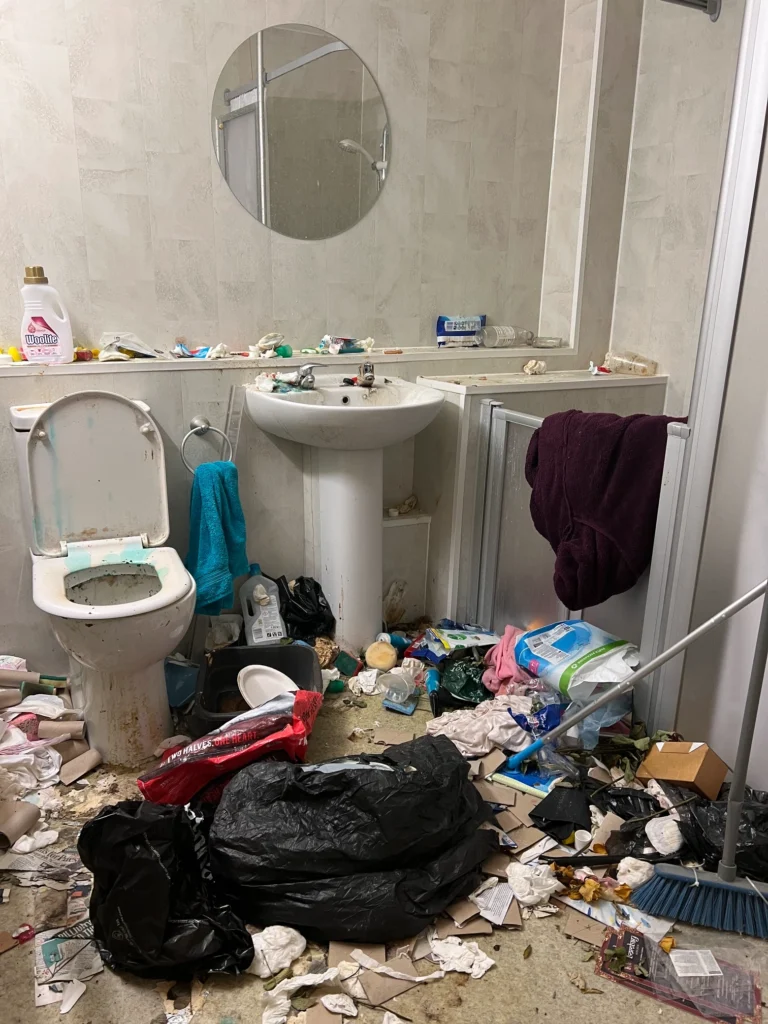
Cleaning cannot always start with a vacuum, mop and bucket. When a property is heavily cluttered, filled with unwanted belongings, affected by rubbish or has areas that cannot be safely accessed, professional property clearance may need to happen first.
This is particularly important for landlords, homeowners, estate agents, property managers and families dealing with neglected or difficult properties. Trying to clean around furniture, waste, bags, boxes and accumulated possessions can make the process slower, less effective and sometimes unsafe.
Professional property clearance creates the physical access needed for proper cleaning. Once unwanted contents and waste have been removed, cleaners can reach floors, skirting boards, cupboards, walls, appliances and other areas that would otherwise remain inaccessible.
For properties across London and surrounding areas, Vamoose Cleaning Services provides specialist cleaning support for difficult and neglected properties, including clearance and preparation before deeper cleaning where required. Its approach is designed around the condition of the property rather than simply applying a standard cleaning checklist.
What Does Professional Property Clearance Mean?
Professional property clearance involves removing unwanted furniture, household contents, rubbish, debris and other items from a property so that the space can be safely and practically used, cleaned, renovated, sold or occupied.
It can involve an entire house, flat, room, garage, loft, commercial property or selected areas. The work may be relatively straightforward, such as removing furniture left after a tenant moves out, or much more complex when a property has severe clutter, long term neglect or significant waste.
Clearance is different from ordinary cleaning. Cleaning removes dirt, dust, grease, stains and contamination from surfaces. Clearance removes physical objects that prevent those surfaces from being reached.
This distinction matters because cleaning teams cannot properly clean an area that is hidden behind piles of belongings or blocked by furniture and rubbish.
A professional clearance may include:
- Removing unwanted furniture
- Removing household contents
- Clearing rubbish and loose waste
- Removing bags, boxes and accumulated belongings
- Clearing floors and access routes
- Removing unwanted appliances where agreed
- Clearing garages, sheds, lofts and storage areas
- Preparing heavily cluttered rooms for deep cleaning
- Sorting items for removal, reuse, recycling or disposal
- Supporting specialist cleaning where the property has become heavily neglected
The exact scope depends on the property and the condition of the contents.
When Is Professional Property Clearance Needed Before Cleaning?

Professional property clearance is usually needed before cleaning when the contents of the property prevent cleaners from safely reaching the surfaces and areas that need attention.
A useful test is simple: Can a cleaning professional safely access the floors, surfaces, appliances, fixtures and affected areas without first moving or removing significant amounts of property contents?
If the answer is no, clearance should normally be considered before deep cleaning begins.
There are several common situations where this happens.
1. The Property Is Heavily Cluttered
A property does not need to be officially classed as a hoarded property before clutter becomes a problem for cleaning.
Boxes covering floors, furniture blocking rooms, bags stacked in hallways and belongings filling work surfaces can all prevent cleaners from reaching the areas that require attention.
For example, imagine a three bedroom house where the kitchen worktops are covered with boxes, the hallway is filled with bags and two bedrooms contain furniture and possessions stacked almost to the walls.
A cleaner may be able to wipe the exposed surfaces, but that is not the same as properly deep cleaning the property.
Professional clearance can create working space first. Once the floors and surfaces are accessible, cleaning can be carried out more thoroughly.
2. Furniture and Belongings Are Preventing Access
Sometimes a property is not particularly dirty, but there is simply too much furniture or too many belongings for a proper clean to take place.
This commonly occurs after a tenant leaves furniture behind or when a property is being prepared for sale.
Large wardrobes, sofas, beds, shelving units and unwanted appliances can make it impossible to clean behind or underneath them.
If the objective is to prepare an empty property for new occupants or marketing photographs, removing unwanted contents before cleaning can produce a much better result.
Vamoose supports landlords, tenants, homeowners and property teams with specialist cleaning services and can assess the condition of a property before recommending the appropriate cleaning approach.
3. Rubbish Has Accumulated Inside the Property
Accumulated rubbish is another clear indication that clearance may need to happen before cleaning.
This could include food packaging, unwanted household items, broken furniture, bags of rubbish, old appliances or general waste left behind after a tenancy.
Cleaning around piles of rubbish is inefficient and can leave hidden dirt, odours and contaminated areas untreated.
The better sequence is usually:
- Assess the property
- Identify what needs to remain
- Remove agreed unwanted items
- Clear waste and debris
- Open up the affected areas
- Carry out the appropriate cleaning and sanitation
- Inspect the finished property
This sequence allows the cleaning team to work systematically instead of repeatedly moving the same items around.
4. A Tenant Has Left the Property Full of Belongings
Landlords and letting agents can face a difficult situation when an outgoing tenant leaves furniture, personal possessions or rubbish behind.
A standard end of tenancy clean may not be enough if the property has not actually been cleared.
For example, a landlord may need a property ready for a new tenant within a short timeframe. If furniture and unwanted belongings remain inside, the cleaning team may not be able to complete the required work.
In this situation, property clearance can be the first stage, followed by deep cleaning or end of tenancy cleaning.
Vamoose provides end of tenancy cleaning services for properties that need to be restored before being marketed or handed over to new occupants.
5. The Property Has Been Neglected for a Long Period
Long term neglect can create a combination of clutter, dirt, grease, dust, unpleasant odours and restricted access.
A property that has been empty for months or years may also have accumulated belongings, rubbish and debris.
In these situations, cleaning should not necessarily be treated as a normal domestic clean.
The property may first need to be cleared and assessed so that the cleaning team can determine what areas require intensive treatment.
Vamoose specifically describes its neglected property cleaning process as including clearance and preparation before deeper cleaning. Its team clears rubbish and loose debris and prepares affected rooms before moving into deep cleaning and sanitation.
This is an important distinction because the first objective may be to make the property accessible and workable rather than immediately make every surface spotless.
6. Hoarding or Severe Clutter Is Present
Hoarding situations require particular care because the issue is not simply about cleaning.
Large quantities of possessions can restrict movement, cover floors, block doors, prevent access to bathrooms or kitchens and create hygiene concerns.
Professional support can help establish a practical sequence in which contents are assessed and removed before intensive cleaning begins.
The process should be respectful and carefully planned. Important personal belongings should not be discarded without appropriate permission.
Vamoose provides specialist hoarder cleaning support involving decluttering, waste clearance, sanitisation and reorganisation where required.
A clearance team should also understand that not everything visible in a cluttered property is waste. Documents, photographs, valuables and sentimental possessions may need to be identified and retained.
7. Probate or Bereavement Clearance Is Required
After a death, a property may contain decades of personal possessions, furniture and household contents.
Cleaning cannot always begin effectively until the property has been sorted and the items that need to remain have been identified.
Probate clearance often involves more than simply removing rubbish. Families or executors may need to decide what should be retained, distributed, donated, recycled or disposed of.
Only after those decisions have been made can the property be cleared sufficiently for a deep clean.
A useful approach is to separate the project into two stages:
Stage one: sort and clear the contents.
Stage two: clean and prepare the property.
This is particularly useful when the property needs to be sold or prepared for handover.
8. A Property Is Being Prepared for Sale
Presentation matters when a property is going on the market.
Rooms filled with unwanted furniture, rubbish or personal belongings can make professional cleaning more difficult and can also make the property look smaller or less maintained.
Clearance before cleaning can help create an empty, accessible space.
Once the unwanted contents have been removed, cleaners can focus on floors, walls, windows, kitchens, bathrooms and other surfaces.
For estate agents and homeowners working towards a viewing or marketing deadline, combining clearance and cleaning into one coordinated project can reduce unnecessary delays.
9. Renovation or Building Work Has Left Debris Behind
After renovation work, a property can contain packaging, dust, protective materials, leftover building debris and unwanted items.
This may require a combination of clearance and specialist cleaning.
The first priority is to remove items that are no longer needed and clear the work areas. The cleaning stage can then address fine dust, residues and other post construction contamination.
Vamoose also provides after builders cleaning services for properties requiring detailed cleaning after construction or renovation work.
10. Floors Cannot Be Reached
One of the simplest signs that clearance should happen before cleaning is when large areas of flooring are inaccessible.
If carpets are covered with boxes, furniture or belongings, cleaners cannot properly vacuum, shampoo or treat those areas.
The same applies to hard flooring.
Removing unnecessary contents first allows the cleaning team to inspect the entire floor and identify stains, damage, damp issues or other problems that may have been hidden.
This can be particularly important when a property is being prepared for a new tenant or buyer.
11. Kitchens and Bathrooms Are Blocked
Kitchens and bathrooms require thorough cleaning because they contain multiple surfaces and fixtures that need attention.
If cupboards, worktops, sinks, toilets, showers or floors are blocked by belongings, rubbish or unwanted items, the cleaner may not be able to complete the work properly.
A kitchen filled with bags, boxes and abandoned appliances may require clearance before degreasing and sanitation can begin.
Similarly, a bathroom being used for storage may need its contents removed before the floor, shower, toilet, sink and other surfaces can be cleaned.
12. The Property Contains Items That May Create a Safety Risk
Clearance may also be necessary when objects create trip hazards, restrict movement or prevent safe access.
Blocked stairways, narrow walkways, unstable piles of possessions and heavy objects can make cleaning difficult and potentially dangerous.
Professional teams need enough space to move equipment safely.
If cleaners cannot move through a property without climbing over belongings or working around unstable piles, the correct response is not simply to start cleaning faster. The property should be assessed and the access problem addressed first.
What Happens If You Try to Clean Before Clearing the Property?
Trying to clean a heavily cluttered property without clearance can create several problems.
Cleaning takes longer
The cleaning team may spend a significant amount of time moving objects instead of actually cleaning.
Some areas remain untouched
Hidden floors, corners, skirting boards and surfaces may remain inaccessible.
Results are less consistent
A property may appear cleaner without actually receiving the deep clean that was expected.
Items can get in the way of specialist equipment
Professional cleaning may require vacuum cleaners, extraction machines, steam equipment or other commercial equipment. Restricted access makes this harder.
Safety risks increase
Workers may have to navigate narrow spaces, unstable piles or blocked routes.
The final cost can increase
A cleaning quotation based on an accessible property may no longer reflect the actual work required if significant clearing becomes necessary.
For these reasons, assessing the property before work begins is often more efficient than discovering halfway through a cleaning appointment that the property needs a clearance first.
Property Clearance Before Cleaning: A Practical Decision Checklist
If you are unsure whether clearance is required, consider these questions:
- Can the cleaners walk safely through every room?
- Can they reach the floors?
- Are kitchen and bathroom surfaces accessible?
- Are there piles of rubbish or unwanted belongings?
- Is furniture preventing access to walls and floors?
- Are stairways and entrances clear?
- Are there strong odours or visible signs of neglect?
- Has a previous tenant left significant belongings?
- Does the property contain years of accumulated possessions?
- Is there a probate or bereavement situation?
- Are there potential hygiene or contamination concerns?
- Does the property need to be emptied before sale or renovation?
If you answer yes to several of these questions, professional clearance before cleaning may be the most practical option.
What Is the Correct Order: Clearance or Cleaning?

For most heavily cluttered properties, the logical order is:
Step 1: Property assessment
The team identifies the property type, condition, access requirements, contents and cleaning needs.
Step 2: Identify what stays and what goes
The client or authorised person confirms which belongings need to remain and which items can be removed.
Step 3: Clearance
Unwanted furniture, rubbish and agreed contents are removed.
Step 4: Waste handling
Removed materials should be handled and disposed of through appropriate routes.
Step 5: Deep cleaning
Once the property is accessible, the cleaning team can work through the agreed areas.
Step 6: Specialist treatment
Where necessary, additional services such as odour treatment, sanitation, carpet cleaning or specialist cleaning can be carried out.
Step 7: Final inspection
The property is checked against the agreed scope of work.
This sequence is not mandatory for every property. A lightly cluttered home may simply need normal cleaning. The important point is that the cleaning method should reflect the actual condition of the property.
What About Waste Disposal During Property Clearance?
Waste disposal should be treated as part of the clearance process rather than an afterthought.
Businesses handling waste in England may have legal responsibilities relating to waste carrier registration and documentation. GOV.UK states that businesses transporting waste, or arranging for waste to be handled, may need to register as a waste carrier, broker or dealer.
For non hazardous commercial waste, GOV.UK also explains that a waste transfer note or equivalent documentation is required for each load moved from business premises, with records generally retained for two years.
You can read the official GOV.UK guidance on waste transfer notes for the current requirements.
If hazardous waste is involved, additional requirements can apply, including specific documentation and authorised disposal arrangements.
For property owners and managers, this is another reason to use an experienced professional rather than simply asking someone to take unwanted materials away.
Can Clearance and Cleaning Be Done as One Project?
Yes. In many cases, combining clearance and cleaning can make the project considerably easier.
The key is to treat them as separate stages within one coordinated service.
For example, a neglected property may require:
- Removal of rubbish
- Removal of unwanted furniture
- Clearance of accessible belongings
- Preparation of rooms
- Deep cleaning
- Odour treatment
- Sanitisation
- Final inspection
This avoids the problem of booking one company for clearance, waiting for that work to finish and then searching for another provider to clean the property.
Vamoose offers specialist cleaning support for neglected properties and difficult cleaning situations across London and nearby counties. Its published process includes assessing the property, selecting the appropriate service, agreeing the plan, carrying out the work and completing a final inspection.
Practical Example: Landlord Preparing a Rental Property
Consider a landlord in West London whose tenant has left behind furniture, bags of rubbish, kitchen items and several boxes.
The property itself is not heavily soiled, but the contents cover much of the floor.
Booking only a standard end of tenancy clean would not solve the problem because the cleaner cannot access the entire property.
The better approach is to arrange clearance first. Once the unwanted contents have been removed, the cleaning team can clean the kitchen, bathrooms, floors, skirting boards, windows and other agreed areas.
The result is a property that is genuinely ready for inspection or a new tenant rather than a property that has simply had the accessible surfaces cleaned.
Practical Example: A Neglected Empty House
A family may inherit a property that has been unoccupied for several years.
Inside are old furnishings, boxes, household belongings and accumulated rubbish. There may also be dust, grime, unpleasant odours and areas of heavy dirt.
In this situation, clearance is normally an essential first stage.
Once the rooms are accessible, a specialist cleaning team can identify the appropriate cleaning methods and work systematically through the property.
Vamoose’s neglected property cleaning service specifically addresses properties affected by heavy clutter, grime and long term neglect, with clearance and preparation followed by deep cleaning and sanitation.
Practical Example: A Hoarded Property
A hoarded property requires an even more considered approach.
The objective is not simply to remove everything as quickly as possible. Items may have emotional, financial or practical value, and the person connected to the property may need to be involved in decisions about what is removed.
The clearance should therefore be planned carefully.
After safe access has been created, professional cleaning can address surfaces, floors, bathrooms, kitchens and other affected areas.
Where hygiene or contamination risks are present, the cleaning plan may need to go beyond conventional domestic cleaning.
Vamoose provides specialist hoarder cleaning support across London and surrounding areas, combining decluttering, clearance and cleaning support where appropriate.
Practical Example: Property Sale After a Bereavement
A property may need to be prepared for sale following a bereavement.
The family has already removed important possessions, but furniture, boxes and unwanted household items remain.
A clearance can remove the remaining agreed contents. A professional deep clean can then restore the property before photography, viewings or handover.
This two stage approach can make the property easier to present and gives the cleaning team access to areas that were previously blocked.
How Much Does Professional Property Clearance Cost?
There is no single price that applies to every property clearance.
The cost can depend on:
- Property size
- Number of rooms
- Volume of contents
- Type of items
- Number of workers required
- Access to the property
- Stairs or restricted access
- Distance involved
- Disposal requirements
- Urgency
- Whether specialist cleaning is also required
A small partial clearance can be very different from a full house clearance involving several rooms of furniture and waste.
For this reason, a property assessment or detailed photographs can often provide a more useful basis for a quotation than a generic price list.
Vamoose states that its pricing varies according to the type and size of the job and recommends contacting the team for an accurate quotation. Its FAQ also explains that free site visits may be arranged for many jobs before a price is provided.
How Long Does Clearance Take Before Cleaning?
The timeframe depends on the amount of material that needs to be removed and the property’s access conditions.
A lightly cluttered flat may require only a short clearance, while a large neglected house can take considerably longer.
Other factors include:
- How much furniture is present
- Whether items need dismantling
- How far items need to be carried
- Whether there are stairs
- Whether a lift is available
- Parking and access restrictions
- The type of waste involved
- Whether additional cleaning is required
If the property has a strict deadline, explain this during the initial enquiry so the team can determine whether the requested schedule is realistic.
When Clearance Is Not Necessary Before Cleaning
Not every property needs professional clearance before cleaning.
A normal cleaning service may be sufficient when:
- The property is already reasonably accessible
- Furniture is staying in place
- There is little or no unwanted waste
- Floors and surfaces can be reached
- The kitchen and bathroom are accessible
- The property does not contain excessive clutter
- The main problem is dirt rather than physical contents
For example, a furnished family home may simply need a deep clean after years of normal use. There is no reason to arrange a full property clearance if the cleaner can safely access the areas included in the service.
The purpose of professional clearance is not to remove items unnecessarily. It is to make the property accessible and manageable when its contents prevent the required cleaning or preparation work.
Why Professional Assessment Matters
One of the most useful steps is arranging an assessment before the work begins.
An experienced team can consider:
- The condition of each room
- The amount of clutter
- Access routes
- Furniture and heavy items
- Waste requirements
- Cleaning requirements
- Hygiene concerns
- Urgency
- Property management restrictions
This can prevent misunderstandings about what is included.
Vamoose’s service process starts by understanding the property, its location, urgency and required cleaning support before recommending the appropriate service.
Why Vamoose Cleaning Services Can Help
Vamoose Cleaning Services specialises in difficult and specialist cleaning situations across London and surrounding counties.
Its services include deep cleaning, neglected property cleaning, hoarder cleaning, emergency cleaning, biohazard cleaning, trauma cleaning and end of tenancy cleaning.
The company also highlights an experienced, DBS checked and fully insured team, free estimates and flexible appointments. Its published service areas include London, Watford, Surrey, Hertfordshire, Middlesex and Buckinghamshire.
This can be particularly useful when a property needs more than a conventional domestic clean.
Instead of trying to decide whether you need clearance, deep cleaning, specialist cleaning or a combination of services, you can describe the property’s condition and allow the team to recommend the appropriate approach.
For properties requiring intensive work, Vamoose also provides specialist deep cleaning and property restoration support.
Frequently Asked Questions
Does a property need to be completely empty before professional cleaning?
No. A property does not normally need to be completely empty. However, areas that need cleaning should be accessible, and significant clutter or unwanted contents may need to be removed first.
Should I clear a property before booking a deep clean?
If the property contains large amounts of unwanted furniture, rubbish or belongings that prevent access, clearance before deep cleaning is usually sensible. If the property is accessible and the contents are staying, a normal deep clean may be sufficient.
Can professional cleaners remove rubbish before cleaning?
Some specialist cleaning providers can coordinate clearance and cleaning, but the exact scope should be agreed before the job. Waste handling may also involve legal requirements depending on the type and source of waste.
Is property clearance needed before end of tenancy cleaning?
It may be needed when a tenant has left furniture, belongings or rubbish behind. Once the property is cleared, the cleaning team can access the areas needed for the end of tenancy clean.
Is clearance necessary for a hoarded property?
Often, yes. Severe clutter can restrict movement, cover surfaces and create hygiene or safety concerns. A planned clearance can create access before specialist cleaning begins.
Can clearance and cleaning happen on the same day?
Sometimes. The answer depends on the amount of clearance required, the size of the property, access and the cleaning work involved. A site assessment can help establish whether a same day service is realistic.
What should I do with valuable or sentimental belongings?
Do not assume they are waste. Identify items that need to be kept, returned to family members, donated or otherwise handled before clearance begins. In probate or sensitive situations, obtain appropriate authorisation before anything is removed.
What if the property has hazardous waste?
Tell the cleaning or clearance provider before work begins. Hazardous waste can require specific handling, documentation and authorised disposal arrangements.
Do landlords benefit from combining clearance and cleaning?
Yes. Combining the stages can reduce delays between a tenant leaving and the property being ready for inspection, marketing or re letting. It also means the cleaning team can work after the property has been made accessible.
Does Vamoose provide cleaning after property clearance?
Vamoose provides specialist cleaning for neglected, cluttered and difficult properties and can assess what cleaning support is required after clearance. Its published neglected property process specifically includes clearance and preparation before deep cleaning.
Final Thoughts: Clear First When Contents Are Preventing Proper Cleaning
The key question is not whether every property needs to be empty before cleaning. The real question is whether the property’s contents are preventing cleaners from safely and effectively reaching the areas that need attention.
If furniture, rubbish, boxes, belongings or severe clutter are blocking floors, surfaces, kitchens, bathrooms, access routes or other areas, professional property clearance may need to come first.
For landlords, homeowners, estate agents and property managers, getting this sequence right can save time and prevent a cleaning appointment from becoming unnecessarily complicated.
If the property is neglected, heavily cluttered, affected by hoarding, left full of belongings after a tenancy, or being prepared for sale or handover, professional assessment is often the best starting point.
Vamoose Cleaning Services can assess the condition of your property and help determine whether you need clearance, deep cleaning, specialist cleaning or a combination of services. You can request a free estimate from Vamoose Cleaning Services to discuss the property and the work required.
Need to discuss your property? You can also view the Vamoose Cleaning Services Google Business Profile for local business information and customer reviews.