
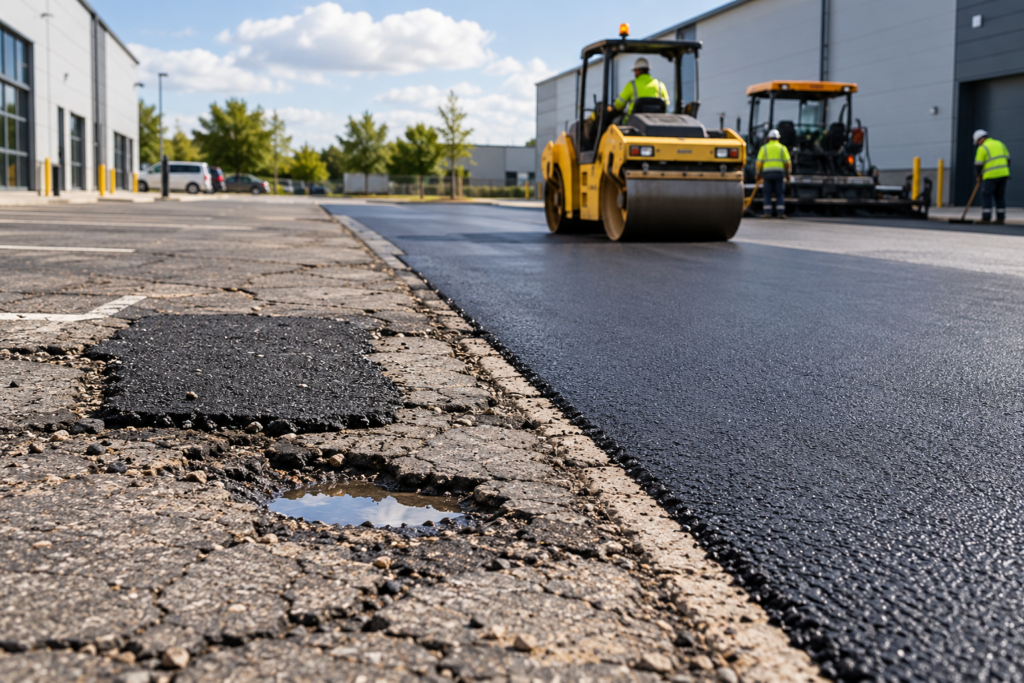
Damaged surfacing is more than an appearance problem for commercial properties. Potholes, cracks, uneven areas and standing water can affect vehicle movements, pedestrian access, daily operations and the overall condition of a site.
When a defect appears, it may be tempting to choose the quickest and cheapest solution. Filling a pothole with loose material or covering a damaged area might make the surface look better temporarily, but it does not always address the cause of the problem.
If water continues entering the pavement, the surrounding asphalt is deteriorating or the underlying foundation has weakened, the defect may return. Repeated temporary repairs can then lead to additional maintenance, recurring disruption and higher costs over time.
Professional surface repairs take a different approach. Instead of simply covering visible damage, a suitable contractor assesses the defect, investigates its likely cause and recommends a repair method based on the condition of the existing surface.
For businesses managing car parks, access roads, industrial yards, warehouses and retail premises, this approach can help protect the property and keep outdoor areas suitable for everyday use.
Batten Civil Engineering Ltd provides commercial surfacing, patching, road and car park surfacing, groundwork and related civil engineering services across the South East of England.
In this guide, we explain why professional surface repairs matter, the limitations of temporary fixes and how commercial property owners can choose the right solution for damaged surfacing.
What Are Temporary Surface Fixes?
Temporary surface fixes are short term measures used to manage a defect before a more suitable repair can be completed.
They can be useful in certain circumstances, particularly when a damaged area creates an immediate safety concern and permanent work cannot be arranged straight away.
Examples include placing temporary warning signs around a pothole, restricting access to an unsafe section or using an appropriate temporary repair material where the method is suitable for the conditions.
However, a temporary measure should not automatically be treated as a permanent repair.
For example, filling a pothole without properly preparing the damaged area may leave loose material, weak edges or gaps through which water can enter. If the surrounding pavement or foundation is already failing, the visible defect may return even if the hole initially appears to be filled.
The important distinction is that temporary measures help manage an immediate problem, while professional repairs aim to restore the surface according to its actual condition and requirements.
The appropriate solution depends on the type of damage, traffic loading, weather conditions, drainage and the construction beneath the surface.
Why Do Commercial Surfaces Develop Problems?
Commercial surfaces experience repeated use from vehicles, pedestrians, delivery operations and site machinery. Over time, this activity can contribute to deterioration, especially when combined with environmental exposure or inadequate maintenance.
Understanding why damage develops is essential before deciding how to repair it.
Heavy Vehicle Traffic
Industrial yards, distribution centres and commercial access roads may accommodate heavy goods vehicles, delivery vans and other vehicles throughout the day.
Repeated loading can place considerable stress on the pavement. Turning, braking and stationary heavy loads may create additional pressure in particular areas.
If the surface or underlying construction is unsuitable for these demands, cracking, rutting, settlement and potholes may develop.
A quick patch may improve the appearance of the damaged area, but recurring defects may indicate that the pavement needs a more substantial repair.
Water Ingress and Drainage Problems
Water is a common contributor to pavement deterioration.
When water enters through cracks, damaged joints or poorly maintained edges, it may affect the materials supporting the surface. Where drainage is inadequate, standing water can place further pressure on already damaged areas.
If a pothole repeatedly develops near a drain or in a low point, the problem may involve more than the visible asphalt.
A professional assessment should consider the drainage system, surface levels and condition of the underlying construction before recommending a solution.
Read Batten’s guide to how drainage problems damage commercial surfacing and how to prevent them.
Ageing and General Wear
Commercial surfaces gradually wear under traffic and environmental exposure.
Older asphalt may develop cracks, lose aggregate or become uneven. Once deterioration becomes widespread, repairing every defect individually may no longer be the most practical approach.
Depending on the condition of the existing pavement, a contractor may recommend targeted repairs, resurfacing or reconstruction of affected sections.
Poor Previous Repairs
Repairs that are not properly prepared or completed can fail prematurely.
For example, a patch may deteriorate if damaged material has not been removed adequately, the surrounding edges are unstable or the repair has not been compacted correctly.
This does not mean that every failed repair was caused by poor workmanship. The original defect may also have involved drainage, heavy traffic or structural problems.
The key is to investigate why the repair failed before repeating the same approach.
1. Temporary Fixes May Not Address the Root Cause
One of the main limitations of a quick repair is that it may deal only with the visible symptom.
A pothole, for example, is a sign that part of the pavement has deteriorated. Its cause may involve water ingress, weakened asphalt, poor joints, inadequate compaction or failure in the supporting layers.
If the cause remains unresolved, the defect may return.
Why this matters for commercial properties
Imagine a warehouse access road where potholes repeatedly appear in the same wheel tracks.
Filling each hole might temporarily improve the surface, but the repeated damage could indicate that the pavement is struggling to support the vehicles using it.
A professional contractor can inspect the affected area and determine whether the problem is localised or part of a wider failure.
Depending on the findings, the appropriate solution could be a properly prepared patch, a deeper repair involving the foundation or a larger resurfacing project.
The objective is not necessarily to undertake the largest possible repair. It is to choose a solution that addresses the problem effectively.
2. Poor Repairs Can Create Safety Concerns
Damaged surfacing can affect everyone using a commercial site.
Drivers may need to manoeuvre around potholes, pedestrians may encounter uneven surfaces, and delivery vehicles may have difficulty moving safely through damaged access areas.
Temporary repairs that become loose, uneven or degraded can create further problems.
Risks for vehicles
Potholes and sudden changes in surface level can affect vehicle movement and may damage tyres or other vehicle components.
This can be particularly concerning in busy loading areas, industrial estates and commercial car parks where vehicles regularly turn, reverse or travel close to pedestrians.
Risks for pedestrians
Cracks, uneven patches and loose materials may create trip hazards. Standing water can also conceal defects or contribute to slippery conditions.
Businesses should not assume that a small defect is harmless simply because it does not currently affect vehicles.
Managing immediate hazards
If a defect creates an immediate risk, the responsible site manager should arrange appropriate temporary controls, such as restricting access or providing suitable warnings, while organising an assessment and repair.
The exact response depends on the location, severity of the defect and site conditions.
Temporary safety measures are important, but they should not become a reason to leave a significant defect unresolved indefinitely.
3. Repeated Temporary Repairs Can Increase Long Term Costs
A quick fix may have a lower initial price than a professional repair. However, the initial cost does not tell the whole story.
If a defect returns repeatedly, the business may need to pay for additional visits, labour, materials and traffic management.
Each repair may also require staff time to arrange the work and communicate access restrictions to employees, customers or suppliers.
The hidden cost of repeat work
Consider a commercial car park with several potholes.
If the defects are isolated and the surrounding surface is stable, professional patching may be the most economical solution.
However, if potholes continue appearing across the site, arranging separate repairs without investigating the wider condition may become inefficient.
A professional assessment can help determine whether the business would benefit from grouping repairs into one project or considering resurfacing.
This does not mean resurfacing is always cheaper. A properly targeted patch may be the better option where the damage is genuinely localised.
The important point is to compare the cost of an appropriate repair with the likely cost of repeatedly treating the same problem.
Planning maintenance budgets
Professional advice can help property managers identify urgent repairs, plan future maintenance and allocate budgets more effectively.
Instead of reacting to every new defect, businesses can use inspection findings to establish which areas require immediate attention and which can be addressed through planned maintenance.
Batten’s commercial surfacing maintenance checklist for property managers provides further guidance on identifying defects and prioritising maintenance.
4. Water Can Make Existing Damage Worse
Water deserves particular attention because a small defect can create an entry point for moisture.
When water penetrates cracks or damaged joints, it may reach the materials beneath the surface. Depending on the pavement construction and ground conditions, this can contribute to weakening, movement and further deterioration.
Repeated rainfall and changes in temperature may increase the impact on vulnerable areas.
Why simply filling a hole may not be enough
If water continues to enter around a repair, the surrounding material may remain vulnerable.
A more suitable repair may require removing damaged asphalt, preparing sound edges, checking the affected area and addressing any underlying problem before new material is installed.
Drainage may also need attention if water is collecting repeatedly in the same location.
Why drainage checks matter
A professional contractor should consider whether water is flowing away from the surface correctly and whether gullies, channels or other drainage features are functioning as intended.
Installing a new patch or surface without addressing a known drainage issue may allow deterioration to continue.
For commercial properties, checking drainage alongside surfacing repairs can help identify problems that would otherwise be missed.
5. Professional Repairs Can Restore Surface Performance
A good repair should be based on the actual condition of the pavement and the demands placed on it.
Professional patching is not simply the act of putting new material into a hole. It involves preparing the damaged area and installing the repair so that it works with the surrounding surface.
The precise method depends on the defect and the project’s specification.
What does professional patching involve?
A typical repair may include:
- Inspecting the defect and assessing its extent.
- Identifying the likely cause of the damage.
- Removing loose or failed material.
- Cutting or planing the repair area back to suitable edges.
- Assessing and repairing the underlying layers where necessary.
- Applying suitable bonding materials where specified.
- Installing and compacting replacement surfacing.
- Finishing the joints and checking the completed repair.
Not every repair requires every stage, and the depth of the work depends on the condition of the pavement.
The important difference is that the repair is planned around the defect rather than simply covering it.
Batten’s approach to patching
Batten Civil Engineering provides patching for damaged tarmac and concrete surfaces. Its published service information describes the use of a skid steer planer to remove damaged material precisely, with repair depths depending on the requirements of the affected area.
Batten also describes sealing the top joints with hot pour bitumen as part of its patching process to help reduce water penetration.
Learn more about Batten’s professional patching service.
6. When Is Patching Enough, and When Is Resurfacing Better?
Professional repairs do not always mean replacing a large section of the surface.
The right option depends on how widespread the damage is and whether the pavement beneath it remains suitable.
When localised patching may be appropriate
Patching may be suitable when:
- The defect is limited to a specific area.
- The surrounding surface remains in reasonable condition.
- The underlying construction is stable or can be repaired locally.
- The cause of the damage can be addressed.
- The repair can be completed without unnecessary work elsewhere.
For example, an isolated pothole near a service entrance may need only a properly prepared patch if the surrounding asphalt and foundation are sound.
When resurfacing may be more suitable
Resurfacing may be worth considering when:
- Cracking or surface wear affects a large area.
- Numerous potholes are appearing across the site.
- Previous patches are failing repeatedly.
- The surface has become rough or uneven over much of its area.
- Individual repairs are becoming increasingly frequent.
- A more consistent surface is needed across the site.
Resurfacing can renew a substantial area without automatically replacing every structural layer beneath it.
However, if the foundation has failed, the surface has experienced significant settlement or drainage problems remain unresolved, additional corrective work may be necessary.
When deeper reconstruction may be required
Some defects extend beyond the asphalt layer.
Widespread settlement, significant structural cracking or repeated failure in the same location may indicate that the supporting layers require attention.
In such cases, the contractor may need to remove and rebuild affected sections before installing the final surface.
For a detailed comparison, read Batten’s guide to car park patching or full resurfacing.
7. Professional Repairs Help Businesses Reduce Operational Disruption
Commercial surfaces are often essential to daily operations.
A car park supports staff and customer access. An industrial yard allows goods to move between loading areas. An access road may be necessary for deliveries, visitors and emergency vehicles.
When defects repeatedly require attention, businesses can face repeated disruption.
Planning work around business activity
A professional contractor can help the site manager plan the work around operational requirements.
Depending on the layout and repair scope, this may include:
- Completing repairs in manageable sections.
- Coordinating work with delivery schedules.
- Identifying temporary parking arrangements.
- Maintaining suitable pedestrian routes.
- Agreeing how vehicles will enter and leave the site.
- Communicating when repaired areas can reopen.
Not every project can be completed without restricting access, but good planning can help reduce avoidable disruption.
Why a single planned project may be more practical
If several defects need attention, it may be sensible to assess them together rather than arrange separate visits for each problem.
A coordinated programme can help the contractor identify related defects, group suitable repairs and consider whether part of the site would benefit from resurfacing.
The most appropriate arrangement depends on the site and the findings of the assessment.
For more advice, see Batten’s guide to planning commercial surfacing work around business operations.
8. Surface Quality Matters for Your Business Image
The external condition of a commercial property contributes to the impression it creates for visitors, customers, employees and business partners.
A car park filled with potholes, loose materials and uneven patches may make a site appear poorly maintained.
For retail premises, hotels, offices and business parks, this can affect how welcoming and professionally managed the property appears.
However, appearance should not be the only reason for arranging repairs.
A visually improved surface must also be suitable for its intended use. A new layer of asphalt may make an area look better, but if the underlying construction is unstable, the defect could return.
Professional assessment helps businesses consider both the appearance and performance of the finished surface.
9. Professional Repairs Support Better Maintenance Planning
Reactive maintenance involves responding after a defect becomes noticeable or creates a problem.
Planned maintenance uses inspections and records to identify deterioration earlier and schedule appropriate work.
Both approaches have a role. Some defects develop unexpectedly, and urgent repairs cannot always be planned in advance. However, relying entirely on reactive repairs can make maintenance harder to manage.
Keep records of recurring defects
Property managers should record the location, type and condition of significant defects.
Photographs and inspection notes can help establish whether the same area is deteriorating repeatedly or whether new problems are developing elsewhere.
For example, if potholes regularly appear near a loading bay, the pattern may indicate a problem related to traffic loading, drainage or the underlying pavement.
Prioritise repairs according to risk
Not all defects need the same response.
An immediate hazard in a busy vehicle route may require urgent action, while minor deterioration in a low use area may be suitable for planned maintenance.
The responsible manager should assess the risk, arrange suitable temporary controls where needed and obtain professional advice for defects that require specialist repair.
Use inspection findings to plan budgets
A maintenance record can help businesses identify recurring expenditure and decide whether a larger project should be considered.
This does not guarantee that every repair will last indefinitely. It does, however, provide a clearer basis for decisions than repeatedly authorising the same repair without reviewing its performance.
10. What Should You Look for in a Professional Surfacing Contractor?
Choosing a suitable contractor is important when the aim is to resolve a defect rather than cover it temporarily.
Businesses should look for a provider that can explain the proposed repair, identify the limitations of the available options and work around the site’s operational needs.
Relevant commercial experience
Ask whether the contractor has experience with the type of site involved, such as an office car park, retail park, industrial yard or commercial access road.
The expected traffic and loading requirements can influence the appropriate repair method.
A clear assessment of the damage
The contractor should inspect the affected area and consider the surrounding surface, drainage and underlying construction where relevant.
Be cautious about accepting a recommendation for extensive work without a reasonable explanation of why it is needed.
A clear written quotation
The quotation should describe the proposed work and identify what is included.
Depending on the project, this may cover material removal, preparation, patching, resurfacing, base repairs, drainage work, waste removal and reinstatement of markings.
Clarify any exclusions and how unexpected issues will be handled.
Appropriate equipment and working methods
Ask how the contractor intends to prepare and repair the surface.
The equipment and method should be suitable for the size, depth and nature of the defect.
A practical plan for access and safety
The contractor should explain how workers, vehicles and pedestrians will be kept separate from the work area and when the repaired section can safely reopen.
For operational commercial sites, this planning is an important part of delivering the work effectively.
Why Choose Batten Civil Engineering Ltd?
Batten Civil Engineering Ltd provides surfacing and civil engineering services for commercial and residential properties across Sussex, Surrey, Kent and London.
Its published services include road and car park surfacing, patching, groundwork, drainage, kerbing and line marking.
This range of services can be useful when a damaged surface requires more than a simple repair. For example, a recurring pothole may need investigation of the surrounding asphalt, while a wider problem could involve drainage or the supporting construction.
Batten’s patching service uses specialist equipment to remove damaged material and prepare the repair area. The company also offers wider surfacing services for projects where localised patching is not the most suitable option.
Every site is different, so the recommended work should be based on the actual condition of the surface and the demands of the property.
To discuss your requirements, visit Batten Civil Engineering Ltd or explore its patching services.
Frequently Asked Questions
1. Why are professional surface repairs better than temporary fixes?
Professional repairs are based on the condition and likely cause of the damage. They may involve removing failed material, preparing the affected area and addressing underlying problems where necessary. Temporary fixes can be useful for short term risk management, but they may not resolve the cause of a defect.
2. Can a pothole simply be filled?
The appropriate method depends on the size, location and cause of the pothole. A properly prepared patch may be suitable for an isolated defect. Simply placing material into a hole without suitable preparation may result in a repair that fails prematurely.
3. When should a commercial surface be resurfaced?
Resurfacing may be appropriate when deterioration affects a substantial area, cracks and potholes are widespread or repeated repairs are becoming impractical. A contractor should assess the condition of the existing pavement before recommending this option.
4. Why do potholes return after repairs?
Potholes may return because water continues entering the pavement, the surrounding surface is deteriorating, traffic loads are excessive for the construction or the underlying layers are weak. The cause should be investigated before the same repair is repeated.
5. Are temporary repairs ever appropriate?
Yes. Temporary measures may be necessary to manage an immediate hazard or maintain access until permanent work can be arranged. They should be suitable for the conditions and followed by further action where required.
6. How can businesses reduce surfacing maintenance costs?
Regular inspections, early identification of defects and appropriate repairs can help businesses plan maintenance. Where damage repeatedly returns, a professional assessment can help determine whether a larger repair would be more practical than continuing with separate interventions.
7. Does drainage affect the success of surface repairs?
Yes. Water entering damaged pavement or collecting in low areas can contribute to further deterioration. Drainage and surface levels should be considered when recurring defects or standing water are present.
8. Can professional repairs be completed while a commercial site remains open?
Sometimes. Depending on the site layout and work required, repairs can be completed in phases to maintain access to selected areas. The contractor should agree on suitable traffic management and pedestrian arrangements with the site manager.
9. What information should I provide when requesting a repair quotation?
Explain the location and type of defect, when it appeared, whether it has been repaired before and what traffic uses the area. Photographs can help with an initial discussion, although a site assessment may still be needed to determine the appropriate solution.
10. How can I arrange professional surface repairs with Batten?
Visit Batten’s website or its patching service page to discuss your requirements and request a quotation. You can also visit its Google Business Profile for business information.
Final Thoughts
Temporary surface fixes can be useful when an immediate problem needs to be managed, but they are not always a suitable long term solution.
For commercial properties, repeated potholes, cracking, uneven surfaces and standing water may indicate problems that need proper investigation. Simply covering the visible damage can leave the underlying cause unresolved, allowing deterioration and disruption to continue.
Professional surface repairs take a more considered approach. By assessing the defect, checking relevant drainage and ground conditions, and choosing a suitable repair method, businesses can make better decisions about maintenance and future investment.
The right solution may be a localised patch, broader resurfacing or deeper reconstruction. What matters is matching the work to the actual condition of the pavement rather than choosing a temporary fix simply because it appears cheaper at first.
If your commercial car park, access road or industrial yard has recurring surface defects, contact Batten Civil Engineering Ltd to discuss the condition of your site and the repair options available.
Visit Batten’s website or its Google Business Profile to learn more.