

A void that sits empty because no one wants to walk into it costs more than an ordinary void. Rent stops the moment a tenancy ends, but the clock does not pause while a housing officer works out who is qualified to clear a property full of needles, years of hoarded belongings, or the aftermath of a death that went unnoticed for weeks. For housing associations and councils across London and the home counties, high risk clearance is a recurring operational problem, not a rare exception.
This guide sets out what makes a property clearance high risk, the legal responsibilities that sit behind it, and how housing teams can build a process that protects staff, tenants, and the wider organisation while getting properties back into use quickly.
Housing associations manage stock at a scale that private landlords rarely deal with, which means high risk cases are not isolated incidents but a recurring line item in the void management budget. A large stock spread across London, Surrey, Middlesex, Watford, and Hertfordshire will see a mix of hoarding, biohazard, and severe neglect cases every year, often several at once. Treating each one as a one off problem, solved from scratch by whoever happens to be on shift when the referral lands, leads to inconsistent outcomes, longer void periods, and avoidable risk to staff. Building a repeatable process is what separates housing teams that manage this well from those constantly firefighting it.
What Counts as a High Risk Property Clearance

Most void turnarounds are routine. A high risk clearance is different because the property presents a genuine danger to anyone who enters it without the right training, equipment, or legal authority. This typically includes biohazard contamination, hoarding severe enough to block access or create structural strain, infestation, or the presence of drug paraphernalia and sharps.
Housing associations tend to encounter these properties in a handful of recurring circumstances: a tenant who has died and was not found for some time, a long term tenant with declining mental health or mobility whose home has become unmanageable, a property vacated after a safeguarding intervention, or a unit affected by fire, flood, or extended neglect. None of these situations are rare across a large housing stock, and each one carries its own set of legal and practical obligations before the property can be relet.
Common High Risk Scenarios Housing Associations Face
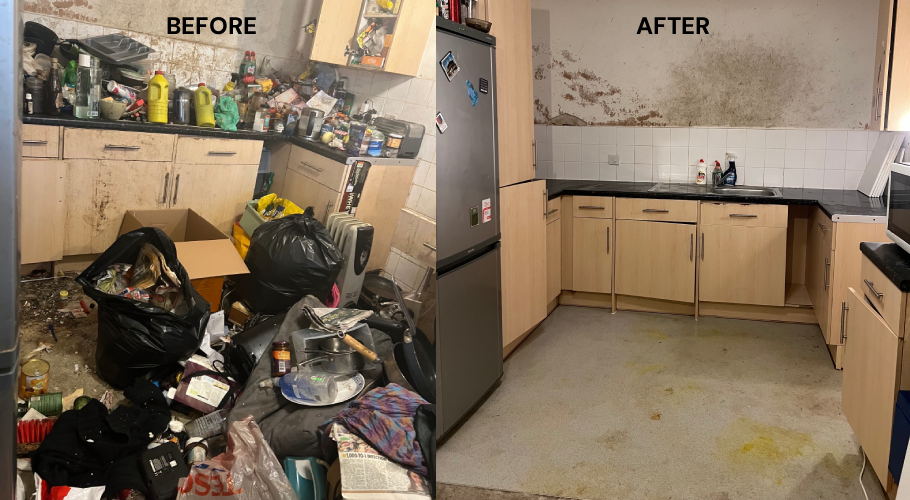
Hoarding and severe clutter. Years of accumulated belongings can block fire exits, hide structural damage, and create conditions for pest infestation. Hoarding cases often involve a tenant who needs support rather than eviction, which changes how the clearance should be handled. A specialist hoarders clearance approach sorts belongings before removing them, which matters when a housing officer needs to identify tenancy documents, benefits paperwork, or items a returning tenant will want kept. It also reduces the risk of the clearance itself triggering distress for a tenant who is still involved in the process, and it gives support workers a chance to be present for the parts of the clearance that affect the tenant directly.
Unattended deaths. Where a tenant has died and the body was not discovered promptly, the property requires biohazard cleaning before any general clearance work can safely begin. This is not something a standard maintenance team should attempt.
Needles and drug related waste. Properties linked to substance use can contain sharps hidden in furniture, bedding, or bags. A structured needle sweep protocol is required before general clearance staff enter the property.
Severe neglect and infestation. Long periods without cleaning or repair can lead to pest infestation, damp, and structural risk that goes beyond a standard end of tenancy clean.
Fire, smoke, and flood damage. Beyond the physical damage, these properties often carry soot, toxic residue, or water damage that needs specialist treatment before they are safe to enter for extended periods.
Legal and Regulatory Responsibilities Housing Associations Cannot Ignore
Housing associations carry legal obligations that go beyond simply getting a void ready for the next tenant. Under the Housing Health and Safety Rating System, social landlords are expected to identify and address hazards in their stock, and a property left in a dangerous condition after a tenancy ends is not exempt from this scrutiny once a new tenant moves in.
The government’s landlord and agent guide to the Housing Health and Safety Rating System sets out the 21 categories of hazard that inspectors assess, several of which, including personal hygiene and sanitation, domestic hygiene, pests and refuse, and structural collapse, are directly relevant to properties coming out of a high risk clearance. Housing teams should treat this guidance as a baseline for what “safe to relet” actually means, rather than relying on a visual check alone.
There is also a duty of care to staff and contractors under health and safety law. Sending an in house repairs team into a property with biohazard contamination or concealed sharps, without the correct training and protective equipment, exposes the organisation to serious liability if someone is injured. Waste carrier licensing rules also apply to anything removed from the property, particularly where volumes are large or materials are classed as hazardous.
Documentation and Reporting Requirements
Housing associations answer to regulators, boards, and tenants in a way that private landlords generally do not, and a high risk clearance should leave a clear paper trail behind it. This means keeping the initial risk assessment, the contractor’s method statement, waste transfer notes confirming legal disposal, and photographic evidence of the property before and after the work.
This record serves several purposes. It protects the organisation if a decision is later questioned, for example if a former tenant or their family disputes how belongings were handled. It supports internal reporting on void turnaround performance, since high risk cases should be tracked separately from standard voids rather than dragging down average turnaround figures in a way that hides the real picture. It also gives the organisation an evidence base if a regulator or the Housing Ombudsman asks how a specific case was managed, which is increasingly common where a case has safeguarding implications.
A specialist contractor that provides this documentation as standard, rather than only on request, saves housing officers from having to chase paperwork after the fact, when memories of the specific case have faded and staff may have moved on.
Safeguarding and Tenant Sensitivity Considerations
High risk clearances frequently sit alongside a safeguarding case rather than a straightforward tenancy end. A hoarding situation might involve a vulnerable adult who is still living in the property, or has recently been moved into supported accommodation. A death may leave grieving relatives who want time to identify personal items before anything is removed.
Housing officers are rarely trained to manage both the physical clearance and the human side of these situations at the same time. Building a referral pathway to a specialist clearance provider, alongside the organisation’s existing safeguarding and mental health support routes, keeps the physical work and the welfare support running in parallel rather than one delaying the other. Our referral guide for social workers and mental health teams sets out how this coordination typically works in practice and is a useful reference for housing teams working alongside community and mental health services.
Health and Safety Risks for In House Repairs Teams
It is worth being direct about why high risk properties should not be handled by general maintenance staff. Biohazard contamination carries a real risk of infection through bodily fluids, and untrained staff entering such a property without protective equipment risk exposure to bloodborne pathogens. Needles and sharps hidden in bedding, furniture, or rubbish bags can cause injury even to experienced staff who are not specifically trained to search for them. Mould and prolonged damp exposure can trigger respiratory issues, particularly with repeated exposure across multiple properties.
A specialist biohazard cleaning team works to strict legal and safety requirements, with full risk assessments, protective equipment, and a project plan for every job. This is not a step housing associations should try to shortcut with general labour, however tight the void turnaround target might be.
Building a Referral and Escalation Process
The housing associations that manage high risk clearances most efficiently tend to have a clear internal process rather than making decisions case by case. A workable process usually includes:
- A simple checklist that helps housing officers identify when a property qualifies as high risk, rather than relying on individual judgement
- An approved list of specialist contractors covering biohazard, hoarding, and extreme deep cleaning work
- A clear line of communication with social services, mental health teams, or safeguarding leads where the case involves a current or former tenant with support needs
- A standard process for securing the property and restricting access until specialist work is complete
- A record keeping system that captures risk assessments, waste disposal documentation, and photographic evidence for the property file
Having this in place before a case arises means staff are not improvising under pressure when a genuinely difficult property comes up, which is when mistakes and delays tend to happen.
Void Turnaround Timelines and Costs
High risk clearances take longer than standard voids, and housing teams should build this into performance targets rather than measuring every void against the same benchmark. A hoarding case with a manageable volume of belongings might be cleared and cleaned within a few days. A biohazard case, or a severely neglected property with structural concerns, can take a week or more once assessment, specialist cleaning, and any necessary repairs are factored in.
Costs vary with the scale of contamination, the volume of waste, and whether specialist disposal is required for hazardous materials. Housing associations working with a single trusted provider across their stock tend to get more consistent, competitive pricing than sourcing a different contractor for every case, since the provider already understands the organisation’s reporting requirements and standard processes.
Several factors consistently affect how long a high risk clearance takes and what it costs. Access matters, since a top floor flat with no lift takes longer to clear than a ground floor unit with parking nearby. The condition of the property matters even more, as a case involving structural concerns or extensive pest activity may need repairs scheduled before reinspection can happen, extending the void period beyond the clearance itself. The presence of hazardous waste, including sharps, chemicals, or biohazard material, adds specialist disposal costs that a standard clearance quote would not include.
Housing teams that track these cases separately in their reporting, rather than blending them into general void statistics, get a much clearer picture of where the real pressure points sit across their stock. This also makes it easier to justify budget for a proper specialist contract, rather than treating each high risk case as an unplanned emergency spend.
What to Look for in a High Risk Clearance Contractor
Not every cleaning company is equipped for this work. Housing teams should look for a provider that can demonstrate:
- Full insurance cover and registration as a licensed waste carrier
- Documented risk assessments and project plans for every job, not just a verbal agreement
- Specific experience with biohazard, hoarding, and needle sweep protocols, not just general end of tenancy cleaning
- A discreet, trauma informed approach, given that many cases involve a recent death, safeguarding concern, or mental health crisis
- Coverage across the housing association’s full stock area, whether that spans London boroughs, Surrey, Middlesex, Watford, or Hertfordshire
A provider that can be called on repeatedly across a large housing stock, rather than sourced fresh for every incident, reduces the administrative burden on housing officers and shortens the time between a property becoming void and being ready to relet.
A Step by Step Process for Housing Teams
- Identify and assess. A housing officer or void inspector flags the property as high risk using an agreed checklist, and photographs are taken to support the referral.
- Secure the property. Access is restricted until a specialist assessment has taken place, protecting both staff and the property itself.
- Specialist risk assessment. The clearance provider visits, confirms the scope of work, identifies any biohazard or needle sweep requirements, and provides a written plan and cost estimate.
- Sensitive review period. Where relevant, family members or support workers are given the opportunity to identify belongings before general clearance begins.
- Clearance and specialist cleaning. Waste is removed under licensed carrier conditions, biohazard or hoarding work is completed, and the property is deep cleaned to a standard suitable for reinspection.
- Reinspection and sign off. The void team confirms the property meets internal standards, and any outstanding repairs are scheduled before relet.
Frequently Asked Questions
Can our own repairs team clear a biohazard property? This is not advisable. Biohazard contamination carries infection risk and legal handling requirements that general repairs staff are not trained or equipped for. A specialist team should always be used for these cases.
How quickly can a high risk clearance be arranged? Most specialist providers can attend for an assessment within a day or two of referral, with work often starting within the same week depending on the scale of the job and any hazardous waste involved.
What happens to sharps or needles found during clearance? They should never be handled by untrained staff. A structured needle sweep protocol, using the correct containers and disposal route, is required before general clearance can proceed safely.
Do you cover housing stock across London and the surrounding counties? Coverage extends across London and into Surrey, Middlesex, Watford, and Hertfordshire, which allows a single provider to support a housing association’s full geographic footprint rather than splitting the work between local contractors.
How do we budget for high risk clearances when the scale of each case varies so much? A free assessment and written quotation before work begins allows housing teams to compare cost against void targets accurately, and working with one provider across multiple cases usually produces more consistent, comparable pricing over time.
Can a hoarding case be handled without the tenant losing their home? In many cases, yes. A structured, sensitive approach that works alongside social services or a support worker can help a tenant remain in the property once the immediate risk has been addressed, rather than treating hoarding automatically as grounds for eviction.
Getting Started
High risk property clearance is one of the more difficult parts of managing housing stock, but it does not need to be handled reactively every time a case comes up. A clear internal process, a trusted specialist contractor, and a working relationship with safeguarding and support services turn a stressful, unpredictable situation into something a housing team can manage consistently.
Vamoose Cleaning Services works with housing associations, councils, and support teams across London, Surrey, Middlesex, Watford, and Hertfordshire on biohazard cleaning, hoarding clearance, and extreme deep cleaning for high risk voids. You can see feedback from organisations we have worked with on our Google Business Profile, or get in touch to discuss setting up a referral process for your team.